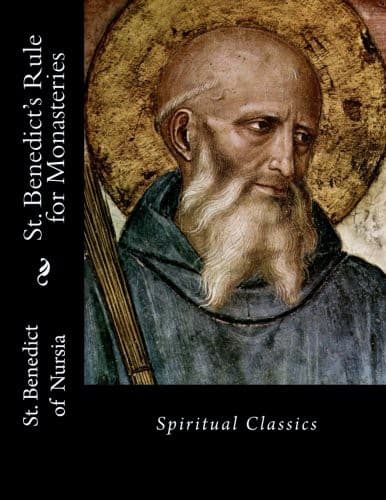
St. Benedict's Rule for MonasteriesBenedict, Saint, Abbot of Monte Cassino
Religion
St. Benedict's Rule for Monasteries
Benedict, Saint, Abbot of Monte Cassino
Benedictines -- Rules
And to show how those who are faithful ought to endure all things,
however contrary, for the Lord, the Scripture says in the person of the
suffering, “For Your sake we are put to death all the day long; we are
considered as sheep marked for slaughter.” Then, secure in their hope of
a divine recompense, they go on with joy to declare, “But in all these
trials we conquer, through Him who has granted us His love.” Again, in
another place the Scripture says, “You have tested us, O God; You have
tried us as silver is tried, by fire; You have brought us into a snare;
You have laid afflictions on our back.” And to show that we ought to be
under a Superior, it goes on to say, “You have set men over our heads.”
Moreover, by their patience those faithful ones fulfil the Lord’s
command in adversities and injuries: when struck on one cheek, they
offer the other; when deprived of their tunic, they surrender also their
cloak; when forced to go a mile, they go two; with the Apostle Paul they
bear with false brethren and bless those who curse them.
Feb. 2—June 3—Oct. 3
The fifth degree of humility is that he hide from his Abbot none of the
evil thoughts that enter his heart or the sins committed in secret, but
that he humbly confess them. The Scripture urges us to this when it
says, “Reveal your way to the Lord and hope in Him,” and again, “Confess
to the Lord, for He is good, for His mercy endures forever.” And the
Prophet likewise says, “My offense I have made known to You, and my
iniquities I have not covered up. I said: ‘I will declare against myself
my iniquities to the Lord;’ and ‘You forgave the wickedness of my
heart.’”
Feb. 3—June 4—Oct. 4
The sixth degree of humility is that a monk be content with the poorest
and worst of everything, and that in every occupation assigned him he
consider himself a bad and worthless workman, saying with the Prophet,
“I am brought to nothing and I am without understanding; I have become
as a beast of burden before You, and I am always with You.”
Feb. 4—June 5—Oct. 5
The seventh degree of humility is that he consider himself lower and of
less account than anyone else, and this not only in verbal protestation
but also with the most heartfelt inner conviction, humbling himself and
saying with the Prophet, “But I am a worm and no man, the scorn of men
and the outcast of the people. After being exalted, I have been humbled
and covered with confusion.” And again, “It is good for me that You have
humbled me, that I may learn Your commandments.”
Feb. 5—June 6—Oct. 6
The eighth degree of humility is that a monk do nothing except what is
commended by the common Rule of the monastery and the example of the
elders.
Feb. 6—June 7—Oct. 7
Public-domain text, read in full here on John Shaqi.
Reviews
Reviews
No reviews yet
Be the first to share your thoughts on this work.
Join the Discussion
Join the discussion
Sign in to leave a comment or review.
Sign InorCreate an account