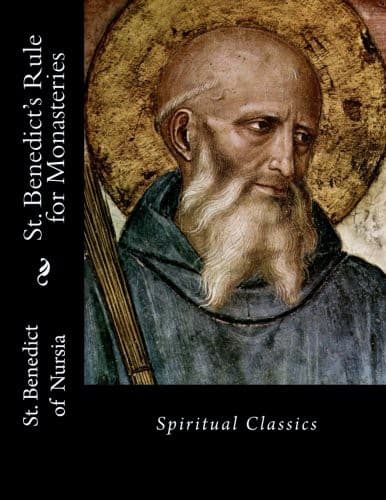
St. Benedict's Rule for MonasteriesBenedict, Saint, Abbot of Monte Cassino
Religion
St. Benedict's Rule for Monasteries
Benedict, Saint, Abbot of Monte Cassino
Benedictines -- Rules
The third kind of monks, a detestable kind, are the Sarabaites. These,
not having been tested, as gold in the furnace, by any rule or by the
lessons of experience, are as soft as lead. In their works they still
keep faith with the world, so that their tonsure marks them as liars
before God. They live in twos or threes, or even singly, without a
shepherd, in their own sheepfolds and not in the Lord’s. Their law is
the desire for self-gratification: whatever enters their mind or appeals
to them, that they call holy; what they dislike, they regard as
unlawful.
The fourth kind of monks are those called Gyrovagues. These spend their
whole lives tramping from province to province, staying as guests in
different monasteries for three or four days at a time. Always on the
move, with no stability, they indulge their own wills and succumb to the
allurements of gluttony, and are in every way worse than the Sarabaites.
Of the miserable conduct of all such men it is better to be silent than
to speak.
Passing these over, therefore, let us proceed, with God’s help, to lay
down a rule for the strongest kind of monks, the Cenobites.
CHAPTER 2
What Kind of Man the Abbot Ought to Be
Jan. 9—May 10—Sept. 9
An Abbot who is worthy to be over a monastery should always remember
what he is called, and live up to the name of Superior. For he is
believed to hold the place of Christ in the monastery, being called by a
name of His, which is taken from the words of the Apostle: “You have
received a Spirit of adoption as sons, by virtue of which we cry,
‘Abba—Father!’”
Therefore the Abbot ought not to teach or ordain or command anything
which is against the Lord’s precepts; on the contrary, his commands and
his teaching should be a leaven of divine justice kneaded into the minds
of his disciples.
Jan. 10—May 11—Sept. 10
Let the Abbot always bear in mind that at the dread Judgment of God
there will be an examination of these two matters: his teaching and the
obedience of his disciples. And let the Abbot be sure that any lack of
profit the master of the house may find in the sheep will be laid to the
blame of the shepherd. On the other hand, if the shepherd has bestowed
all his pastoral diligence on a restless, unruly flock and tried every
remedy for their unhealthy behavior, then he will be acquitted at the
Lord’s Judgment and may say to the Lord with the Prophet: “I have not
concealed Your justice within my heart; Your truth and Your salvation I
have declared. But they have despised and rejected me.” And then finally
let death itself, irresistible, punish those disobedient sheep under his
charge.
Jan. 11—May 12—Sept. 11
Public-domain text, read in full here on John Shaqi.
Reviews
Reviews
No reviews yet
Be the first to share your thoughts on this work.
Join the Discussion
Join the discussion
Sign in to leave a comment or review.
Sign InorCreate an account