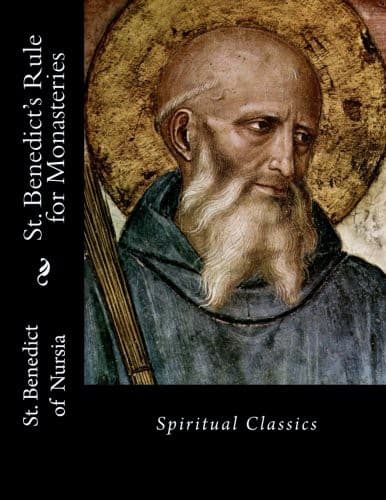
St. Benedict's Rule for MonasteriesBenedict, Saint, Abbot of Monte Cassino
Religion
St. Benedict's Rule for Monasteries
Benedict, Saint, Abbot of Monte Cassino
Benedictines -- Rules
Therefore, when anyone receives the name of Abbot, he ought to govern
his disciples with a twofold teaching. That is to say, he should show
them all that is good and holy by his deeds even more than by his words,
expounding the Lord’s commandments in words to the intelligent among his
disciples, but demonstrating the divine precepts by his actions for
those of harder hearts and ruder minds. And whatever he has taught his
disciples to be contrary to God’s law, let him indicate by his example
that it is not to be done, lest, while preaching to others, he himself
be found reprobate, and lest God one day say to him in his sin, “Why do
you declare My statutes and profess My covenant with your lips, whereas
you hate discipline and have cast My words behind you?” And again, “You
were looking at the speck in your brother’s eye, and did not see the
beam in your own.”
Jan. 12—May 13—Sept. 12
Let him make no distinction of persons in the monastery. Let him not
love one more than another, unless it be one whom he finds better in
good works or in obedience. Let him not advance one of noble birth ahead
of one who was formerly a slave, unless there be some other reasonable
ground for it. But if the Abbot for just reason think fit to do so, let
him advance one of any rank whatever. Otherwise let them keep their due
places; because, whether slaves or freemen, we are all one in Christ and
bear an equal burden of service in the army of the same Lord. For with
God there is no respect of persons. Only for one reason are we preferred
in His sight: if we be found better than others in good works and
humility. Therefore let the Abbot show equal love to all and impose the
same discipline on all according to their deserts.
Jan. 13—May 14—Sept. 13
In his teaching the Abbot should always follow the Apostle’s formula:
“Reprove, entreat, rebuke”; threatening at one time and coaxing at
another as the occasion may require, showing now the stern countenance
of a master, now the loving affection of a father. That is to say, it is
the undisciplined and restless whom he must reprove rather sharply; it
is the obedient, meek and patient whom he must entreat to advance in
virtue; while as for the negligent and disdainful, these we charge him
to rebuke and correct.
And let him not shut his eyes to the faults of offenders; but, since he
has the authority, let him cut out those faults by the roots as soon as
they begin to appear, remembering the fate of Heli, the priest of Silo.
The well-disposed and those of good understanding let him correct with
verbal admonition the first and second time. But bold, hard, proud and
disobedient characters he should curb at the very beginning of their
ill-doing by stripes and other bodily punishments, knowing that it is
written, “The fool is not corrected with words,” and again, “Beat your
son with the rod and you will deliver his soul from death.”
Public-domain text, read in full here on John Shaqi.
Reviews
Reviews
No reviews yet
Be the first to share your thoughts on this work.
Join the Discussion
Join the discussion
Sign in to leave a comment or review.
Sign InorCreate an account