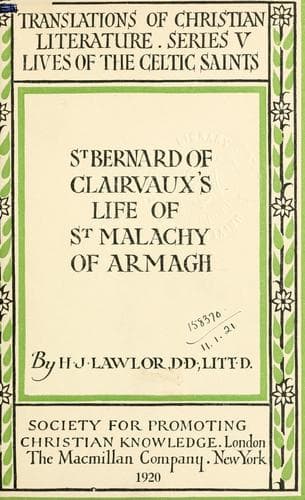
St. Bernard of Clairvaux's Life of St. Malachy of ArmaghBernard, of Clairvaux, Saint
History
St. Bernard of Clairvaux's Life of St. Malachy of Armagh
Bernard, of Clairvaux, Saint
Malachy, Saint, 1094?-1148
Gilbert,[35] the first bishop of Limerick, as has already been noted,
was an Irishman. Indeed, we may venture to describe him as one of the
most remarkable Irishmen of his time, in spite of the fact that the
Annals pass him by in almost complete silence. He was at any rate a
staunch supporter, or, as we should rather say, the leader of the
Reformation movement in its earliest course. In a letter written in 1107
Anselm exhorted him, in virtue of their mutual friendship, to make good
use of his episcopal office by correcting that which was amiss, and
planting and sowing good customs, calling to aid him in the work his
king (Murtough O'Brien), the other Irish bishops, and all whom he could
persuade.[36] That, assuredly, Gilbert was forward to do.
No sooner had he taken possession of his see than he began to organize a
diocese. Its boundaries seem to have been fixed with care. It was
exactly co-extensive with the modern diocese of Limerick, except on the
north, where it stretched across the Shannon and included part of the
present diocese of Killaloe.[37] Moreover he made the Church of St. Mary
his Cathedral Church; indeed it is not unlikely that he built it to
serve that purpose.
A few years later he was appointed Legate of the Holy See. It is
manifest that his new office gave him a unique opportunity of moulding
the fortunes of the Irish Church. In Ireland Gilbert was now virtually
the chief prelate and head of the Church. He was the representative and
embodiment of the authority of the Holy See. The whole Romanizing party
would naturally circle round him as their leader, and many waverers
would be attracted to the new movement in the Irish Church, by the claim
which he could make to speak in the name of the head of the Church
Catholic.
It was after he became legate, and no doubt in virtue of his legatine
commission, that he issued a treatise which may be regarded as the
programme of the Reformation. It is entitled _De Statu Ecclesiae_. Of
this a fragment, including its earlier chapters, is still in our
hands.[38]
Before giving a slight summary of its contents I must mention that it is
addressed "to the bishops and presbyters of the whole of Ireland," and
that Gilbert declares that he wrote it at the urgent request of many of
them. In this statement there may lurk an element of exaggeration. But
behind it there lies at least so much truth as this. A considerable body
of the clergy had approached the newly made legate, and requested his
instruction regarding the proper constitution of the Church--for such is
the subject of his tract; and that implies that the Romanizing movement
was no longer in its infancy. There were many bishops and presbyters who
had become dissatisfied with the old Irish method of Church government.
They desired to bring it into conformity with that of the Roman Church.
But they were in some uncertainty as to the nature of the changes that
should be made, and so they asked Gilbert to give them authoritative
counsel.
Public-domain text, read in full here on John Shaqi.
Reviews
Reviews
No reviews yet
Be the first to share your thoughts on this work.
Join the Discussion
Join the discussion
Sign in to leave a comment or review.
Sign InorCreate an account