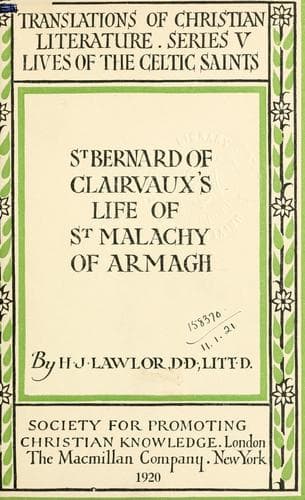
St. Bernard of Clairvaux's Life of St. Malachy of ArmaghBernard, of Clairvaux, Saint
History
St. Bernard of Clairvaux's Life of St. Malachy of Armagh
Bernard, of Clairvaux, Saint
Malachy, Saint, 1094?-1148
The fathers began by appealing to English precedent. "Just as twelve
bishops were fixed under Canterbury in the south of England, and twelve
bishops in the north under the city of York," so it was ordained that
there should be twelve bishops in the south of Ireland, and twelve in
the north. The constitution of the Irish Church was henceforth, it would
seem, to be a copy of that of the English Church. But, as it happens,
neither in 1110 nor in any other year of its history, had the Church of
England twelve sees under Canterbury and twelve under York. How then can
we explain the statement of the Synod? The answer is simple. Bede[50]
preserves a letter of Pope Gregory the Great, written in 601, in which
St. Augustine of Canterbury was directed to consecrate twelve bishops as
his own suffragans. He was also ordered to consecrate a bishop for York,
who, if his mission proved successful, was likewise to consecrate twelve
suffragans, and to be promoted to the dignity of a metropolitan. It is
clear that the Synod found its precedent in this letter, not observing
that Pope Gregory's ordinance was never carried into effect. But they
made another mistake. For Gregory intended that there should be twelve
bishops in the north of England, and twelve in the south, exclusive of
the archbishops, twenty-six in all; while it is evident that the Council
of Rathbreasail intended that there should be twelve bishops in the
north of Ireland, and twelve in the south, including the archbishops,
twenty-four in all. Some one whose lead the Synod followed--probably the
papal legate--had read his Bede with little care. But that is not
surprising. Lanfranc had misread Bede, when on his authority he claimed
to be Primate of Ireland; why should not Gilbert have gone astray in
like fashion? The point to be noticed and emphasized is that the first
act of the Synod was to fix the number of the Irish sees, on the curious
principle that what the wisdom of Pope Gregory held to be good for
England would suit Ireland also.
Apparently the next step in the procedure was to determine the
distribution of the dioceses among the provinces, and to fix the see of
each prospective diocese. Ireland was divided into two portions by a
line running, approximately, from Dublin to Galway. The part to the
north of that line was known as Leath Chuinn, the part to the south as
Leath Mogha. In Leath Chuinn were the provinces of Ulster and Connaught
and the kingdom of Meath; in Leath Mogha were the provinces of Munster
and Leinster. The Synod decreed that there should be five sees in
Ulster, five in Connaught, and two in Meath, making twelve bishoprics
for Leath Chuinn; there were to be seven in Munster and five in
Leinster--twelve bishoprics for Leath Mogha. The names of all these sees
were given in the Acts of the Synod.
Public-domain text, read in full here on John Shaqi.
Reviews
Reviews
No reviews yet
Be the first to share your thoughts on this work.
Join the Discussion
Join the discussion
Sign in to leave a comment or review.
Sign InorCreate an account