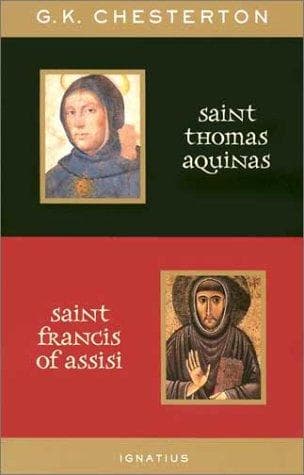
St. Francis of AssisiChesterton, G. K. (Gilbert Keith)
Religion
St. Francis of Assisi
Chesterton, G. K. (Gilbert Keith)
Francis, of Assisi, Saint, 1182-1226
will mean that we must measure the sky before we can begin to measure
the towering stature of the man.
And this phrase alone brings me to the preliminary suggestions that seem
necessary before even a slight sketch of the life of St. Francis. It is
necessary to realise, in however rude and elementary a fashion, into
what sort of a world St. Francis entered and what has been the history
of that world, at least in so far as it affected him. It is necessary to
have, if only in a few sentences, a sort of preface in the form of an
Outline of History, if we may borrow the phrase of Mr. Wells. In the
case of Mr. Wells himself, it is evident that the distinguished novelist
suffered the same disadvantage as if he had been obliged to write a
novel of which he hated the hero. To write history and hate Rome, both
pagan and papal, is practically to hate nearly everything that has
happened. It comes very near to hating humanity on purely humanitarian
grounds. To dislike both the priest and the soldier, both the laurels of
the warrior and the lilies of the saint, is to suffer a division from
the mass of mankind for which not all the dexterities of the finest and
most flexible of modern intelligences can compensate. A much wider
sympathy is needed for the historical setting of St. Francis, himself
both a soldier and a saint. I will therefore conclude this chapter with
a few generalisations about the world that St. Francis found.
Men will not believe because they will not broaden their minds. As a
matter of individual belief, I should of course express it by saying
that they are not sufficiently catholic to be Catholic. But I am not
going to discuss here the doctrinal truths of Christianity, but simply
the broad historical fact of Christianity, as it might appear to a
really enlightened and imaginative person even if he were not a
Christian. What I mean at the moment is that the majority of doubts are
made out of details. In the course of random reading a man comes across
a pagan custom that strikes him as picturesque or a Christian action
that strikes him as cruel; but he does not enlarge his mind sufficiently
to see the main truth about pagan custom or the Christian reaction
against it. Until we understand, not necessarily in detail, but in their
big bulk and proportion that pagan progress and that Christian reaction,
we cannot really understand the point of history at which St. Francis
appears or what his great popular mission was all about.
Public-domain text, read in full here on John Shaqi.
Reviews
Reviews
No reviews yet
Be the first to share your thoughts on this work.
Join the Discussion
Join the discussion
Sign in to leave a comment or review.
Sign InorCreate an account