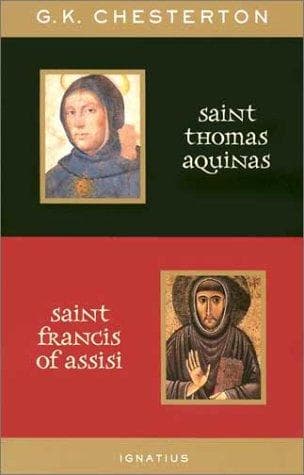
St. Francis of AssisiChesterton, G. K. (Gilbert Keith)
Religion
St. Francis of Assisi
Chesterton, G. K. (Gilbert Keith)
Francis, of Assisi, Saint, 1182-1226
early experiments he was rather too much of a man of action; he acted
too soon and was too practical to be prudent. But at every turn of his
extraordinary career we shall find him flinging himself round corners in
the most unexpected fashion, as when he flew through the crooked streets
after the beggar.
Another element implied in the story, which was already partially a
natural instinct, before it became a supernatural ideal, was something
that had never perhaps been wholly lost in those little republics of
medieval Italy. It was something very puzzling to some people; something
clearer as a rule to Southerners than to Northerners, and I think to
Catholics than to Protestants; the quite natural assumption of the
equality of men. It has nothing necessarily to do with the Franciscan
love for men; on the contrary one of its merely practical tests is the
equality of the duel. Perhaps a gentleman will never be fully an
egalitarian until he can really quarrel with his servant. But it was an
antecedent condition of the Franciscan brotherhood; and we feel it in
this early and secular incident. Francis, I fancy, felt a real doubt
about which he must attend to, the beggar or the merchant; and having
attended to the merchant, he turned to attend to the beggar; he thought
of them as two men. This is a thing much more difficult to describe, in
a society from which it is absent, but it was the original basis of the
whole business; it was why the popular movement arose in that sort of
place and that sort of man. His imaginative magnanimity afterwards rose
like a tower to starry heights that might well seem dizzy and even
crazy; but it was founded on this high table-land of human equality.
I have taken this the first among a hundred tales of the youth of
St. Francis, and dwelt on its significance a little, because until we
have learned to look for the significance there will often seem to be
little but a sort of light sentiment in telling the story. St. Francis
is not a proper person to be patronised with merely "pretty" stories.
There are any number of them; but they are too often used so as to be a
sort of sentimental sediment of the medieval world, instead of being, as
the saint emphatically is, a challenge to the modern world. We must take
his real human development somewhat more seriously; and the next story
in which we get a real glimpse of it is in a very different setting. But
in exactly the same way it opens, as if by accident, certain abysses of
the mind and perhaps of the unconscious mind. Francis still looks more
or less like an ordinary young man; and it is only when we look at him
as an ordinary young man, that we realise what an extraordinary young
man he must be.
Public-domain text, read in full here on John Shaqi.
Reviews
Reviews
No reviews yet
Be the first to share your thoughts on this work.
Join the Discussion
Join the discussion
Sign in to leave a comment or review.
Sign InorCreate an account