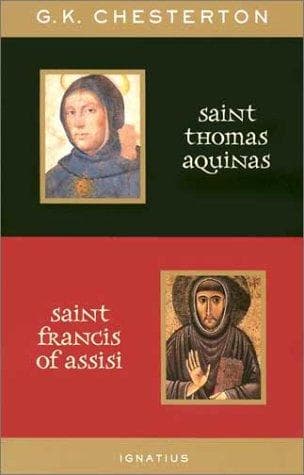
St. Francis of AssisiChesterton, G. K. (Gilbert Keith)
Religion
St. Francis of Assisi
Chesterton, G. K. (Gilbert Keith)
Francis, of Assisi, Saint, 1182-1226
shall not assume any more or any less agreement than this. A materialist
may not care whether the inconsistencies are reconciled or not. A
Catholic may not see any inconsistencies to reconcile. But I am here
addressing the ordinary modern man, sympathetic but sceptical, and I can
only rather hazily hope that, by approaching the great saint's story
through what is evidently picturesque and popular about it, I may at
least leave the reader understanding a little more than he did before of
the consistency of a complete character; that by approaching it in this
way, we may at least get a glimmering of why the poet who praised his
lord the sun, often hid himself in a dark cavern, of why the saint who
was so gentle with his Brother the Wolf was so harsh to his Brother the
Ass (as he nicknamed his own body), of why the troubadour who said that
love set his heart on fire separated himself from women, of why the
singer who rejoiced in the strength and gaiety of the fire deliberately
rolled himself in the snow, of why the very song which cries with all
the passion of a pagan, "Praised be God for our Sister, Mother Earth,
which brings forth varied fruits and grass and glowing flowers," ends
almost with the words "Praised be God for our Sister, the death of the
body."
Renan and Matthew Arnold failed utterly at this test. They were content
to follow Francis with their praises until they were stopped by their
prejudices; the stubborn prejudices of the sceptic. The moment Francis
began to do something they did not understand or did not like, they did
not try to understand it, still less to like it; they simply turned
their backs on the whole business and "walked no more with him." No man
will get any further along a path of historical enquiry in that fashion.
These sceptics are really driven to drop the whole subject in despair,
to leave the most simple and sincere of all historical characters as a
mass of contradictions, to be praised on the principle of the curate's
egg. Arnold refers to the asceticism of Alverno almost hurriedly, as if
it were an unlucky but undeniable blot on the beauty of the story; or
rather as if it were a pitiable break-down and bathos at the end of the
story. Now this is simply to be stone-blind to the whole point of any
story. To represent Mount Alverno as the mere collapse of Francis is
exactly like representing Mount Calvary as the mere collapse of Christ.
Those mountains are mountains, whatever else they are, and it is
nonsense to say (like the Red Queen) that they are comparative hollows
or negative holes in the ground. They were quite manifestly meant to be
culminations and landmarks. To treat the Stigmata as a sort of scandal,
to be touched on tenderly but with pain, is exactly like treating the
original five wounds of Jesus Christ as five blots on His character. You
may dislike the idea of asceticism; you may dislike equally the idea of
martyrdom; for that matter you may have an honest and natural dislike of
Public-domain text, read in full here on John Shaqi.
Reviews
Reviews
No reviews yet
Be the first to share your thoughts on this work.
Join the Discussion
Join the discussion
Sign in to leave a comment or review.
Sign InorCreate an account