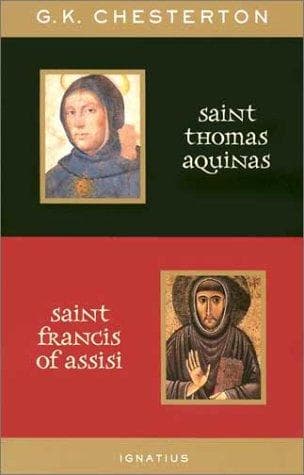
St. Francis of AssisiChesterton, G. K. (Gilbert Keith)
Religion
St. Francis of Assisi
Chesterton, G. K. (Gilbert Keith)
Francis, of Assisi, Saint, 1182-1226
Second, he may go to the opposite extreme, and decide, as it were, to be
defiantly devotional. He may make the theological enthusiasm as
thoroughly the theme as it was the theme of the first Franciscans. He
may treat religion as the real thing that it was to the real Francis of
Assisi. He can find an austere joy, so to speak, in parading the
paradoxes of asceticism and all the holy topsy-turvydom of humility. He
can stamp the whole history with the Stigmata, record fasts like fights
against a dragon; till in the vague modern mind St. Francis is as dark a
figure as St. Dominic. In short he can produce what many in our world
will regard as a sort of photographic negative, the reversal of all
lights and shades; what the foolish will find as impenetrable as
darkness and even many of the wise will find almost as invisible as if
it were written in silver upon white. Such a study of St. Francis would
be unintelligible to anyone who does not share his religion, perhaps
only partly intelligible to anyone who does not share his vocation.
According to degrees of judgment, it will be regarded as something too
bad or too good for the world. The only difficulty about doing the thing
in this way is that it cannot be done. It would really require a saint
to write the life of a saint. In the present case the objections to such
a course are insuperable.
Third, he may try to do what I have tried to do here; and, as I have
already suggested, the course has peculiar problems of its own. The
writer may put himself in the position of the ordinary modern outsider
and enquirer; as indeed the present writer is still largely and was once
entirely in that position. He may start from the standpoint of a man who
already admires St. Francis, but only for those things which such a man
finds admirable. In other words he may assume that the reader is at
least as enlightened as Renan or Matthew Arnold; but in the light of
that enlightenment he may try to illuminate what Renan and Matthew
Arnold left dark. He may try to use what is understood to explain what
is not understood. He may say to the modern English reader: "Here is an
historical character which is admittedly attractive to many of us
already, by its gaiety, its romantic imagination, its spiritual courtesy
and camaraderie, but which also contains elements (evidently equally
sincere and emphatic) which seem to you quite remote and repulsive. But
after all, this man was a man and not half a dozen men. What seems
inconsistency to you did not seem inconsistency to him. Let us see
whether we can understand, with the help of the existing understanding,
these other things that seem now to be doubly dark, by their intrinsic
gloom and their ironic contrast." I do not mean, of course, that I can
really reach such a psychological completeness in this crude and curt
outline. But I mean that this is the only controversial condition that I
shall here assume; that I am dealing with the sympathetic outsider. I
Public-domain text, read in full here on John Shaqi.
Reviews
Reviews
No reviews yet
Be the first to share your thoughts on this work.
Join the Discussion
Join the discussion
Sign in to leave a comment or review.
Sign InorCreate an account