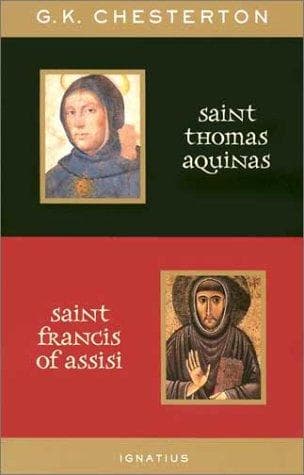
St. Francis of AssisiChesterton, G. K. (Gilbert Keith)
Religion
St. Francis of Assisi
Chesterton, G. K. (Gilbert Keith)
Francis, of Assisi, Saint, 1182-1226
From that cavern, that was a furnace of glowing gratitude and humility,
there came forth one of the strongest and strangest and most original
personalities that human history has known. He was, among other things,
emphatically what we call a character; almost as we speak of a character
in a good novel or play. He was not only a humanist but a humorist; a
humorist especially in the old English sense of a man always in his
humour, going his own way and doing what nobody else would have done.
The anecdotes about him have a certain biographical quality of which the
most familiar example is Dr. Johnson; which belongs in another way to
William Blake or to Charles Lamb. The atmosphere can only be defined by
a sort of antithesis; the act is always unexpected and never
inappropriate. Before the thing is said or done it cannot even be
conjectured; but after it is said or done it is felt to be merely
characteristic. It is surprisingly and yet inevitably individual. This
quality of abrupt fitness and bewildering consistency belongs to
St. Francis in a way that marks him out from most men of his time. Men
are learning more and more of the solid social virtues of medieval
civilisation; but those impressions are still social rather than
individual. The medieval world was far ahead of the modern world in its
sense of the things in which all men are at one: death and the daylight
of reason and the common conscience that holds communities together. Its
generalisations were saner and sounder than the mad materialistic
theories of to-day; nobody would have tolerated a Schopenhauer scorning
life or a Nietzsche living only for scorn. But the modern world is more
subtle in its sense of the things in which men are not at one; in the
temperamental varieties and differentiations that make up the personal
problems of life. All men who can think themselves now realise that the
great schoolmen had a type of thought that was wonderfully clear; but it
was as it were deliberately colourless. All are now agreed that the
greatest art of the age was the art of public buildings; the popular and
communal art of architecture. But it was not an age for the art of
portrait-painting. Yet the friends of St. Francis have really contrived
to leave behind a portrait; something almost resembling a devout and
affectionate caricature. There are lines and colours in it that are
personal almost to the extent of being perverse, if one can use the word
perversity of an inversion that was also a conversion. Even among the
saints he has the air of a sort of eccentric, if one may use the word of
one whose eccentricity consisted in always turning towards the centre.
Public-domain text, read in full here on John Shaqi.
Reviews
Reviews
No reviews yet
Be the first to share your thoughts on this work.
Join the Discussion
Join the discussion
Sign in to leave a comment or review.
Sign InorCreate an account