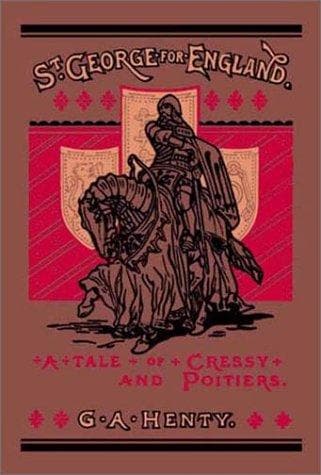
St. George for EnglandHenty, G. A. (George Alfred)
History
St. George for England
Henty, G. A. (George Alfred)
Great Britain -- History -- Edward III, 1327-1377 -- Fiction
Passing the Temple, the boys rowed along by the green banks and fields
as far as Westminster, which at that time was almost a rival of the
city, for here were the abbey and great monastery; here were the king's
palace and court, and the houses of many of his nobles. Then they went
along by the low shores of Millbank, keeping a sharp lookout for boats
going down with the stream. It was already getting dark, for Walter had
not allowed for the strength of the stream, and he was full of anxiety
lest he should arrive too late.
CHAPTER III: A THWARTED PLOT
A boat was rowing rapidly down the stream. It had passed the village of
Chelsea, and the men were doing their best to reach their destination
at Westminster before nightfall. Two men were rowing; in the stern sat
a lady with a girl about eleven years old. A woman, evidently a servant,
sat beside the lady, while behind, steering the boat, was an elderly
retainer.
“It is getting dark,” the lady said; “I would that my cousin James had
not detained us so long at Richmond, and then after all he was unable to
accompany us. I like not being out on the river so late.”
“No, indeed, my lady,” the woman replied; “I have heard tell lately much
of the doings of the river pirates. They say that boats are often picked
up stove in and broken, and that none know what had become of their
occupants, and that bodies, gashed and hewn, are often found floating in
the river.
“How horrible,” the girl said; “your tale makes me shiver, Martha; I
would you had said nothing about it till we were on land again.
“Do not be afraid, Edith,” the lady said cheerfully; “we shall soon be
safe at Westminster.”
There were now only two or three boats to be seen on the river. They
were nearing the end of their journey now, and the great pile of the
Abbey could be seen through the darkness. A boat with several men in
it was seen rowing across the river towards the Lambeth side. It was
awkwardly managed.
“Look out!” the steersman of the boat coming down stream shouted; “you
will run into us if you don't mind.”
An order was given in the other boat, the men strained to their oars,
and in an instant the boat ran with a crash into the side of the other,
cutting it down to the water's edge. For a minute there was a wild scene
of confusion; the women shrieked, the watermen shouted, and, thinking
that it was an accident, strove, as the boat sank from under them, to
climb into that which had run them down. They were speedily undeceived.
One was sunk by a heavy blow with an oar, the other was stabbed with
a dagger, while the assailants struck fiercely at the old man and the
women.
At this moment, however, a third boat made its appearance on the scene,
its occupants uttering loud shouts. As they rowed towards the spot their
approach was heralded by a shower of arrows. Two of the ruffians were
struck--one fell over mortally wounded, the other sank down into the
boat.
Public-domain text, read in full here on John Shaqi.
Reviews
Reviews
No reviews yet
Be the first to share your thoughts on this work.
Join the Discussion
Join the discussion
Sign in to leave a comment or review.
Sign InorCreate an account