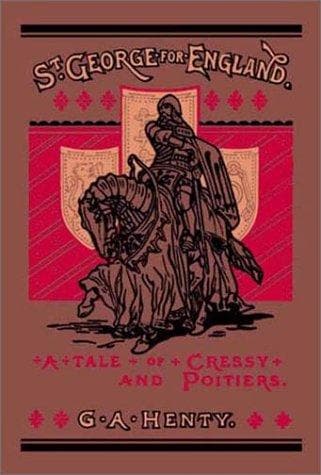
St. George for EnglandHenty, G. A. (George Alfred)
History
St. George for England
Henty, G. A. (George Alfred)
Great Britain -- History -- Edward III, 1327-1377 -- Fiction
“Row, men, row,” their leader shouted, “or we shall all be taken.”
Again seizing their oars, the rowers started at full speed towards the
Lambeth shore. The arrows of their pursuers still fell among them, two
more of their number being wounded before they reached the opposite
shore. The pursuit was not continued, the newcomers ceasing to row at
the spot where the catastrophe had taken place. Walter stood up in the
boat and looked round. A floating oar, a stretcher, and a sheepskin
which had served as a cushion, alone floated.
Suddenly there was a choking cry heard a few yards down stream, and
Walter leapt into the river. A few strokes took him to the side of the
girl, and he found, on throwing his arm round her, that she was still
clasped in her mother's arms. Seizing them both, Walter shouted to his
comrades. They had already turned the boat's head, and in a minute were
alongside.
It was a difficult task to get the mother and child on board, as the
girl refused to loose her hold. It was, however, accomplished, and
the child sat still and quiet by Walter's side, while his comrades
endeavoured to stanch the blood which was flowing from a severe wound in
her mother's head. When they had bound it up they rubbed her hands, and
by the time they had reached the steps at Westminster the lady opened
her eyes. For a moment she looked bewildered, and then, on glancing
round, she gave a low cry of delight at seeing her child sitting by
Walter's side.
On reaching the steps the boys handed her over to the care of the
watermen there, who soon procured a litter and carried her, she being
still too weak to walk, to the dwelling of the Earl of Talbot, where
she said she was expected. The apprentices rowed back to London Bridge,
elated at the success of their enterprise, but regretting much that they
had arrived too late to hinder the outrage, or to prevent the escape of
its perpetrators.
Walter on his return home related the whole circumstance to his master.
“I would you had told me, Walter,” the latter said, “since we might have
taken precautions which would have prevented this foul deed from
taking place. However, I can understand your wanting to accomplish the
adventure without my aid; but we must think now what had best be said
and done. As the lady belongs to the court, there is sure to be a fine
pother about the matter, and you and all who were there will be examined
touching your share of the adventure, and how you came to be upon the
spot. The others will, of course, say that they were there under your
direction; and we had best think how much of your story you had better
tell.”
“Why should I not tell it all?” Walter asked indignantly.
Public-domain text, read in full here on John Shaqi.
Reviews
Reviews
No reviews yet
Be the first to share your thoughts on this work.
Join the Discussion
Join the discussion
Sign in to leave a comment or review.
Sign InorCreate an account