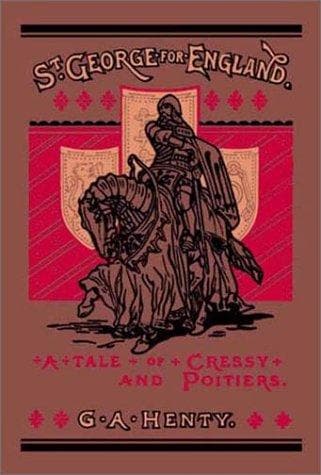
St. George for EnglandHenty, G. A. (George Alfred)
History
St. George for England
Henty, G. A. (George Alfred)
Great Britain -- History -- Edward III, 1327-1377 -- Fiction
The event justified the Prince of Wales's confidence; at the
commencement of the struggle Ralph Smith tried to beat down his opponent
by sheer strength as he had done his prior opponents, but to his
surprise he found that all his efforts could not break down his
opponent's guard. Walter indeed did not appear to take advantage of his
superior lightness and activity, but to prefer to prove that in strength
as well as skill he was equal to his antagonist. In the latter respect
there was no comparison, for as soon as the smith began to relax his
rain of blows Walter took the offensive and with a sweeping blow given
with all his strength broke down his opponent's guard and smote him with
such force upon his steel cap that, blunted as the sword was, it clove
through the iron, and stretched the smith senseless on the ground. A
loud shout broke from the assemblage. The marshal came up to Walter,
and removing his helmet, led him to the royal pavilion, while Ralph was
carried to a tent near, where a leech attended his wound.
CHAPTER VI: THE MELEE
“You have won your prize stoutly and well, sir 'prentice,” the king said.
“I should not have deemed it possible that one of your age could have
smitten such a blow, and right glad should I be of a few hundred lads of
your mettle to follow me against the French. What is your calling?”
“I am an armourer, my liege,” Walter answered.
“And you are as good at mending armour as you are at marring it,” the
king said, “you will be a rare craftsman one of these days. 'Tis a rare
pity so promising a swordsman should be lost to our army. Wouldst like
to change your calling, boy, and take to that of arms?”
“It is my hope to do so, sir,” Walter answered modestly, “and his grace
the Prince of Wales has already promised me that I shall some day ride
behind him to the wars.”
“Ah! Edward,” the king ejaculated, “how is this? Have you been already
enlisting a troop for the wars?”
“No, sir,” the young prince replied, “but one day, now some four years
since, when I was riding with my Lord Talbot and others in the fields
near the Tower I did see this lad lead his play-fellows to the assault
of an earthen castle held by others, and he fought so well and gallantly
that assuredly no knight could have done better, until he was at last
stricken senseless, and when he recovered I told him that should he
choose to be a man-at-arms I would enlist him in my following to the
wars.”
The king laughed.
“I deemed not that the lads of the city indulged in such rough sports;
but I wonder not, seeing that the contingent which my good city of
London furnishes me is ever one of the best in my army. We shall see
the lad at work again tomorrow and will then talk more of it. Now let us
bestow upon him the prize that he has so well earned.”
Walter bent on one knee, and the queen handed to him a sword of the best
Spanish steel, which was the prize given by the city to the victor. The
king handed him a heavy purse of gold pieces, saying:
Public-domain text, read in full here on John Shaqi.
Reviews
Reviews
No reviews yet
Be the first to share your thoughts on this work.
Join the Discussion
Join the discussion
Sign in to leave a comment or review.
Sign InorCreate an account