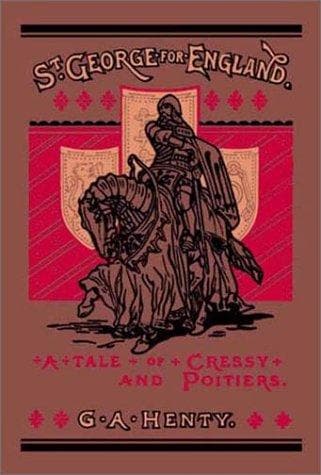
St. George for EnglandHenty, G. A. (George Alfred)
History
St. George for England
Henty, G. A. (George Alfred)
Great Britain -- History -- Edward III, 1327-1377 -- Fiction
The iron caps had stout cheek-pieces which defended the sides of the
face and neck, for even a blunted sword can deliver a terrible blow if
it fall upon the naked flesh. It took a long time to get through the
combats; the pairs were drawn by lot, and fought until the king decided
which was the superior. Some were speedily beaten, at other times
the contests were long and severe. It was generally thought by the
apprentices that the final contest lay between Walter Fletcher of
Aldgate and Ralph Smith of Ludgate. The former was allowed to be
superior in the use of his weapon, but the latter was also skilful, was
two years older, and greatly superior in strength. He had not taken part
in the contest in the preceding year, as he had been laid up with a hurt
in his hand which he had got in his employment as a smith, and the
lads of Ludgate were confident that he would turn the tables upon the
champion of the eastern ward. Both had defeated with ease the various
opponents whom they had met, but it chanced that they had not drawn
together until the last round, when they remained alone to struggle for
the first and second prizes.
The interest in the struggle had increased with each round, and wagers
were freely laid upon the result. According to custom the two champions
had laid aside their leathern shirts and had donned mail armour, for it
was considered that the crowning contest between the two picked young
swordsmen of the city would be a severe one, and greater protection to
the limbs was needed.
Before taking their places they were led up to the royal pavilion, where
they were closely inspected by the king and his nobles.
“You are sure that this man is still an apprentice?” the king asked
the Lord Mayor, who was seated next to him; “he has the appearance of a
man-at-arms, and a stout one too; the other is a likely stripling, and
is, as I have seen, marvellously dexterous with his sword, but he is but
a boy while the other is a grown man.
“He is an apprentice, my liege, although his time will be up in a few
days, while the other has yet three years to serve, but he works for
an armourer, and is famed through the city, boy as he is, for his skill
with weapons.”
After a few words to each, exhorting them to do their best in the sight
of the queen and her ladies, the king dismissed them.
“I know the young one now!” the Prince of Wales said, clapping his hands
as the apprentices turned away to take their places. “My Lord Talbot, I
will wager a gold chain with you upon the smaller of the two.”
“I will take your wager,” the noble answered; “but I am by no means sure
that I shall win it, for I have watched your champion closely, and
the downright blows which he struck would seem to show that he has the
muscle and strength of a man though still but a boy.”
Public-domain text, read in full here on John Shaqi.
Reviews
Reviews
No reviews yet
Be the first to share your thoughts on this work.
Join the Discussion
Join the discussion
Sign in to leave a comment or review.
Sign InorCreate an account