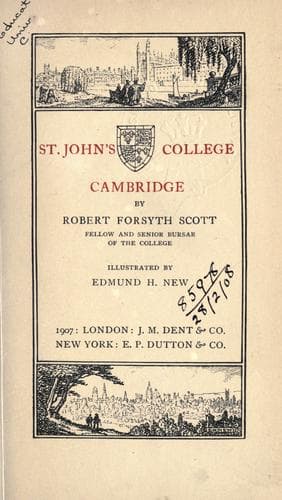
St. John's College, CambridgeScott, Robert Forsyth
History
St. John's College, Cambridge
Scott, Robert Forsyth
St. John's College (University of Cambridge) -- History
_The Chapel Tower from the River_ 67
_The College Chapel from the Round Church_ 75
_The New Court from Trinity College Bridge_ 87
_The "Bridge of Sighs"_ 98
[Illustration: Plan of St John's College]
St. John's College
CHAPTER I
THE COURTS AND BUILDINGS
St. John's College was founded in 1511, in pursuance of the intentions
of the Lady Margaret Beaufort, mother of King Henry VII.
Approaching the College from the street we enter by the Great Gate. The
gateway with its four towers is the best example of the characteristic
Cambridge gate, and dates from the foundation of the College. It is
built of red brick (the eastern counties marble), dressed with stone.
The street front of the College to the right and left remains in its
original state, except that after the old chapel and infirmary of the
Hospital of St. John (to which allusion will be made hereafter) were
pulled down, the north end was completed by a block of lecture rooms in
1869.
The front of the gate is richly decorated with heraldic devices, full of
historical meaning and associations. The arms are those of the
foundress; the shield, France (ancient) and England quarterly, was the
royal shield of the period; the bordure, gobonny argent and azure (the
argent in the upper dexter compartment), was the "difference" of the
Beauforts, and is only slightly indicated. The supporters, two
antelopes, come from Henry VI. There is no crest above the shield, and
heraldic rules are against its use by a lady, but on her seal the Lady
Margaret used the Beaufort arms as above ensigned, with a coronet of
roses and fleur-de-lis, out of which issues an eagle, displayed or; and
this device of coat and crest is used by the College. The arms on the
gate are surrounded by badges, the Portcullis of the Beauforts, the
Tudor, or Union, rose, each surmounted by a crown. Besides these we have
daisies (marguerites), the badge of the Lady Margaret, and some flowers,
which are not so easily identified. Certain vestments and embroideries,
which belonged to the Lady Margaret, of which a list has been preserved,
are described as "garnishede with sophanyes and my ladyes poisy," or,
"with rede roses and syphanyes." The sophanye was an old English name
for the Christmas rose, and there seems little doubt that these flowers
on the gate are meant for Christmas roses. The carving on the right,
under the portcullis, where these emblems seem to be growing out of
something resembling a masonic apron, is very curious.
Public-domain text, read in full here on John Shaqi.
Reviews
Reviews
No reviews yet
Be the first to share your thoughts on this work.
Join the Discussion
Join the discussion
Sign in to leave a comment or review.
Sign InorCreate an account