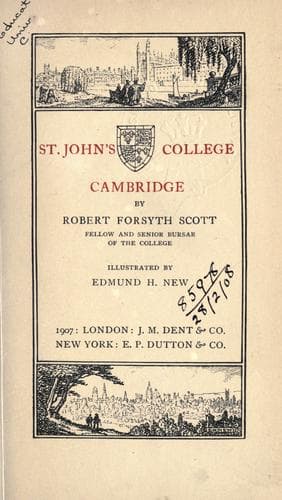
St. John's College, CambridgeScott, Robert Forsyth
History
St. John's College, Cambridge
Scott, Robert Forsyth
St. John's College (University of Cambridge) -- History
Above the gate are two sets of rooms. The upper set has been used from
the beginning as the Treasury or Muniment Room of the College; the set
immediately above the arch is now an ordinary set of rooms. In this set
resided, during his college career, Lord Thomas Howard, a son of the
fourth Duke of Norfolk, afterwards himself first Earl of Suffolk and
Baron Howard de Walden. He fought against the Armada in 1588, and
commanded the expedition to the Azores in 1591; the fame of Sir Richard
Grenville of the _Revenge_ has somewhat eclipsed that of his leader in
the latter case; the reader may recall Tennyson's _Ballad of the Fleet_.
[Illustration: BAG OF FLOWERS OVER ENTRANCE GATEWAY]
To the left of the gate it will be observed that five windows on the
first floor are of larger size than the rest; this was the original
position of the Library; the books were removed in 1616 to a room over
the Kitchen, and later to the present Library. According to tradition
Henry Kirke White, the poet, occupied, and died in, the rooms on the
ground-floor next the tower; he lies buried in the old churchyard of All
Saints', across the street.
Entering the gate the Hall and Kitchen face us, and preserve much of
their original appearance. But right and left the changes have been
great. The old Chapel was swept away in 1869--its foundations are marked
out by cement; at this time the Hall was lengthened, and a second oriel
window added. The range of buildings on the south was raised and faced
with stone about 1775, when the craze for Italianising buildings was
fashionable; it was then intended to treat the rest of the Court in like
manner, but fortunately the scheme was not carried out.
If we walk along the south side of the Court we may notice on the
underside of the lintel of G staircase the words, "Stag, Nov. 15, 1777."
It seems that on that date a stag, pursued by the hunt, took refuge in
the College, and on this staircase; the members of the College had just
finished dinner when the stag and his pursuers entered. On the next
staircase, F, there is a passage leading to the lane with the Kitchen
Offices, this passage is sometimes known as "The Staincoat"; the
passage leading from the Screens into the Kitchen is still sometimes
called "The Staincoat," or "The Stankard." These curious names really
mean the same thing. It appears that in times past a pole was kept,
probably for carrying casks of beer, but on which the undergraduates
seem also to have hoisted those of their number, or even servants, who
had offended against the rules and customs of the College; this pole was
called the Stang, and the place or passage in which it was kept the
Stangate Hole, with the above variations or corruptions.
Public-domain text, read in full here on John Shaqi.
Reviews
Reviews
No reviews yet
Be the first to share your thoughts on this work.
Join the Discussion
Join the discussion
Sign in to leave a comment or review.
Sign InorCreate an account