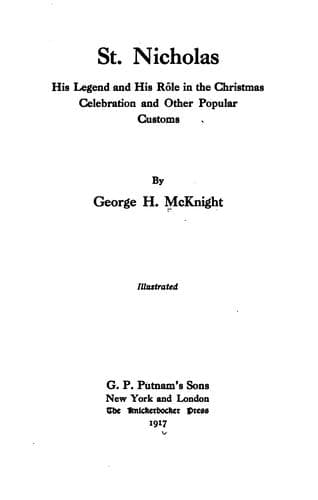
St. Nicholas: His Legend and His Rôle in the Christmas Celebration and Other Popular CustomsMcKnight, George Harley
History
St. Nicholas: His Legend and His Rôle in the Christmas Celebration and Other Popular Customs
McKnight, George Harley
Christmas; Nicholas, Saint, Bishop of Myra
Aside from the coincidence in time between the St. Nicholas festival
and the pagan children’s festival, there was also a point of contact
in one of the best-known of the stories in the life of St. Nicholas,
which, associated with the earlier custom at first in a superficial
way, in time affected its character. The story in question is the
famous one of the young man St. Nicholas and his gifts to the dowerless
maidens. This story in the condensed, not too lively, version in the
Golden Legend, runs as follows:
And when his father and mother were departed out of this life, he
[the young man Nicholas] began to think how he might distribute
his riches, and not to the praising of the world but to the honor
and glory of God. And it was so that one, his neighbour, had
then three daughters, virgins, and he was a nobleman: but for
the poverty of them together, they were constrained, and in very
purpose to abandon them to the sin of lechery, so that by the gain
and winning of their infamy they might be sustained. And when
the holy man Nicholas knew hereof he had great horror of this
villainy, and threw by night secretly into the house of the man a
mass of gold wrapped in a cloth. And when the man arose in the
morning, he found this mass of gold, and rendered to God therefor
great thankings, and therwith he married his oldest daughter. And
a little while after this holy hermit of God threw in another mass
of gold, which the man found and thanked God, and purposed to wake
for to know him that had aided him in his poverty. And after a few
days Nicholas doubled the mass of the gold, and cast it into the
house of this man. He awoke by the sound of the gold and followed
Nicholas, which fled from him, and he said to him: “Sir, flee not
away so but that I may see and know thee.” Then he ran after him
more hastily and knew that it was Nicholas; and anon he kneeled
down, and would have kissed his feet, but the holy man would not,
but required him not to tell nor discover this thing as long as he
lived.
[Illustration: Florentine School (Fifteenth Century). St. Nicholas and
the Three Maidens.]
This is the story which in general has linked the name of St. Nicholas
particularly with the virtue of generosity. For instance, in Dante’s
_Purgatorio_ the shade of Hugh Capet introduces the name of Nicholas in
this connection.
Esso parlava ancor della largezza
che fece Niccolao alle pulcelle,
per condurre ad onor lor giovenezza.
“It spoke further of the generosity of Nicholas toward the maidens
in order to conduct their youth to honor.”
Canto xx., vo. 31-33.
Public-domain text, read in full here on John Shaqi.
Reviews
Reviews
No reviews yet
Be the first to share your thoughts on this work.
Join the Discussion
Join the discussion
Sign in to leave a comment or review.
Sign InorCreate an account