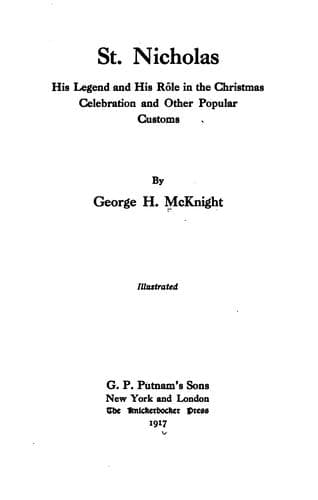
St. Nicholas: His Legend and His Rôle in the Christmas Celebration and Other Popular Customs — John Shaqi
St. Nicholas: His Legend and His Rôle in the Christmas Celebration and Other Popular CustomsMcKnight, George Harley
History
St. Nicholas: His Legend and His Rôle in the Christmas Celebration and Other Popular Customs
McKnight, George Harley
Christmas; Nicholas, Saint, Bishop of Myra
Amongst this year’s worshipers’ was a peasant, John Doulos, from
the village of Bezaïté, who invoked the help of the saint on behalf
of Kyriakula, his young daughter, who was blind. He brought her to
worship at the shrine. The unfortunate girl had lost her sight on
Easter day, when she thought she saw a great fire before her eyes
and fell to the ground. From that moment she could see nothing. All
medical skill was of no avail, and the despairing Doulos determined
to take his daughter to the saint. They arrived at the monastery on
the Wednesday before the festival. Thursday and Friday, days and
nights, they spent inside the church kneeling before the ikon in
prayer and supplication. Suddenly about dawn on the Saturday, when
the worshipers in the church were numerous, Kyriakula arose, and
crossing herself, cried:
“Father, father, I see! There are the saint’s candles! There is the
ikon!”
A thrill of emotion ran through those present, and all joined with
the girl, whose sight had been restored, in worshiping the ikon of
the wonder-working saint. After remaining many hours to bless the
name of the saint, the healed girl left the church with her father
and joined in the festival. Then she returned to her village, and
her restored eyesight told better than words the saint’s miracle.
CHAPTER VII
ST. NICHOLAS PLAYS
In our time the celebration of St. Nicholas’ day has lost much of the
ceremony that was once associated with it. Even in countries like
Belgium and Holland, where the day is a great folk festival, there is
little to connect the day with the story of the beloved bishop-saint.
“Sinterklaes” is better known than St. Nicholas. In early days the case
was different. Particularly in the centuries immediately following the
transfer of the St. Nicholas relics to Italy, the time when the vogue
of the eastern saint reached its height in the countries of western
Europe, in many ways his story was kept fresh in the popular memory.
Not only did the Boy Bishop custom commemorate, in somewhat extravagant
fashion to be sure, the elevation of the boy Nicholas to the rank of
bishop, but stories of the life of the saint formed an important part
of the _lectiones_, or “readings,” for the day in the church; and more
important still, some of the principal episodes in his life formed the
subject, in church schools, for hymns which later developed into little
plays.[69] In the election of the Boy Bishop was reenacted with a great
deal of adventitious detail one of these episodes. In more strictly
dramatic fashion were reenacted the four episodes: (1) of the maidens
saved from a life of shame; (2) the three murdered schoolboys restored
to life; (3) the kidnapped boy restored to his parents; and (4) the Jew
that put his treasures in charge of the image of St. Nicholas.
Public-domain text, read in full here on John Shaqi.
Reviews
Reviews
No reviews yet
Be the first to share your thoughts on this work.
Join the Discussion
Join the discussion
Sign in to leave a comment or review.
Sign InorCreate an account