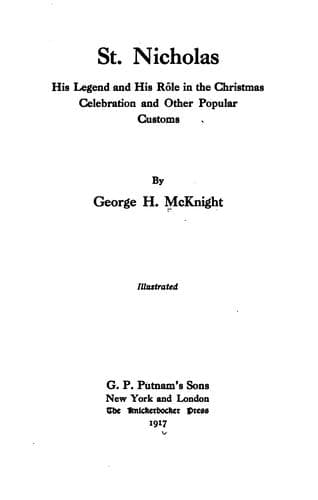
St. Nicholas: His Legend and His Rôle in the Christmas Celebration and Other Popular CustomsMcKnight, George Harley
History
St. Nicholas: His Legend and His Rôle in the Christmas Celebration and Other Popular Customs
McKnight, George Harley
Christmas; Nicholas, Saint, Bishop of Myra
In many other cases, where the direct pagan inheritance is not so
easily traced, saints in modern Greece accomplish functions precisely
similar to those accomplished in ancient times by minor deities. St.
George is regarded as the protector of the crops, probably on account
of the etymology of his name (_Ge_=“earth,” _ergein_=“work”). For a
similar reason, apparently, St. Maura is invoked in case of ulcers or
smallpox. Other saints with similar functions are St. Madertos invoked
in case of pestilence among beasts, St. Blasios in case of sore throat,
and St. John in cases of fever.
People accustomed to seek divine aid in this way, in case of trouble,
are not easily to be deprived of their recourse. If they are forbidden
to worship their pagan divinities, then substitutes must be found.
Thus seamen deprived of Poseidon as source of aid, had recourse to St.
Phokas and later turned to St. Nicholas, possibly, as has been pointed
out, due to the story, in the legend of St. Nicholas, of aid rendered
by him to the ship in distress. The connection once established, St.
Nicholas came more and more to occupy the place formerly held by
Poseidon. Hence probably the position held by St. Nicholas in popular
belief, especially in eastern Christendom, as the guardian of sailors.
There is one modern Greek story of St. Nicholas as patron saint of
seamen which deserves to be told because it shows the occasional
survival, in the popular worship of saints, of pagan elements which
the Christian Church could not countenance. The story, as told by an
old Greek man, is to this effect: “At the time of the Revolution a
number of Greek ships assembled off Kamári. There was great excitement
and trepidation. So they thought things over and decided to send a
man to St. Nicholas to ask him that their ships might prosper in the
war. They accordingly seized a man and took him to the large hall at
Kamári. There they cut off his head and his hands, and carried him
down the steps into the hall.” This was a pagan rite obviously not to
be tolerated by the Christian God, for the story goes, “thereupon God
appeared with a bright torch in his hand, and the bearers of the body
dropped it, and all present fled in terror.”[98]
It is evident that St. Nicholas inherited some of the attributes of
Poseidon, or Neptune. But that does not sum up the extent of his pagan
heritage. Probably earlier than the association of St. Nicholas with
Poseidon is that with Demeter, or Diana, whose cult was particularly
in vogue in Lycia, the scene of the principal events in the story of
St. Nicholas.
Public-domain text, read in full here on John Shaqi.
Reviews
Reviews
No reviews yet
Be the first to share your thoughts on this work.
Elsewhere in the archive
Join the Discussion
Join the discussion
Sign in to leave a comment or review.
Sign InorCreate an account