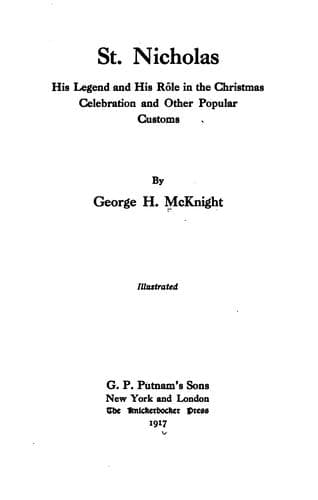
St. Nicholas: His Legend and His Rôle in the Christmas Celebration and Other Popular Customs — John Shaqi
St. Nicholas: His Legend and His Rôle in the Christmas Celebration and Other Popular CustomsMcKnight, George Harley
History
St. Nicholas: His Legend and His Rôle in the Christmas Celebration and Other Popular Customs
McKnight, George Harley
Christmas; Nicholas, Saint, Bishop of Myra
The mysterious events of the ensuing night closely parallel those
recorded for Belgium. St. Nicholas’ robe, his “beste tabbaerd,” enables
him to pass from place to place instantaneously. But in his nightly
journey over the roofs of houses, he uses a horse which the children
of Holland, like those of Belgium, remember by leaving a wisp of hay
for his use.[8] If, for some reason, on account of lack of time or of
money, the parents have neglected to buy gifts, the children say, “St.
Nicholas’ horse has glass legs; he has slipped down and broken his
foot.”[9]
But the joys of St. Nicholas’ eve in Holland are not confined to
children. It is a time, like the Christmas season in England, for
family reunions and the renewal of old memories, also for the giving of
presents. But the manner of the Dutch gift-giving has its distinctive
features, for:
St. Nicholas’ presents must be hidden and disguised as much as
possible and be accompanied by rhymes explaining what the gift is,
and for whom St. Nicholas intended it. Sometimes a parcel addressed
to one person will finally turn out to be for quite a different
member of the family from the one who first received it. For the
address on each wrapper in various stages of wrapping, makes it
necessary for the parcel to change hands as many times as there are
papers to undo. Tiniest things are sent in immense packing cases.
Sometimes the gifts are baked in a loaf of bread or hidden in a
turf. The longer it takes to find the present, the greater the
surprise.
Great delight is taken in concealing the identity of the giver as
long as possible. Even if the gift comes from a member of the same
household, before the parcel is brought in, the doorbell is rung by
a servant in order to create the impression that the parcel has
come from an outsider. For the same purpose a parcel for a friend’s
house is often entrusted to a passer-by.
On the evening of the celebration, after St. Nicholas has said his
adieux, promising to come again, the children are packed away to
bed, and the older people have their special amusement. They sit
about a table in the middle of the room and partake of tea and
“speculaas,” a spice cake bearing a great picture of St. Nicholas,
until their own surprises begin to arrive. When this part of the
program is over, about ten o’clock, the room is cleared; the dust
sheet laid down for the children’s scramble, is removed, the
papers, boxes, baskets, and the like, used in packing the presents,
are cleared away. The table is spread with a white tablecloth, and
when all have taken seats, a dish of boiled chestnuts, steaming
hot, is brought in and eaten with butter and salt.[10]
Public-domain text, read in full here on John Shaqi.
Reviews
Reviews
No reviews yet
Be the first to share your thoughts on this work.
Join the Discussion
Join the discussion
Sign in to leave a comment or review.
Sign InorCreate an account