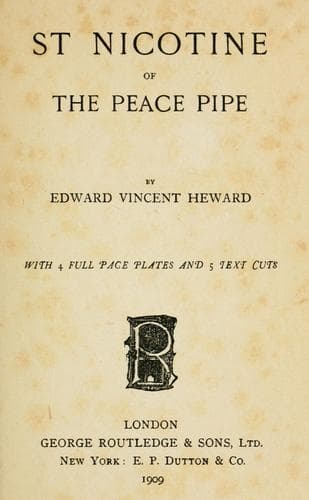
St Nicotine of the Peace PipeHeward, Edward Vincent
History
St Nicotine of the Peace Pipe
Heward, Edward Vincent
Smoking; Tobacco
It was noticeable that the stern denouncer of talk did not say how he,
personally, would have liked a seat in a ‘parliament reduced to its
simplest expression.’ Electrical glances passed from one to another of
the immortals, which clearly indicated that the inflexible one would
have kicked the seat from under him, and, taking his stand on the eternal
verities, would have lashed with the scorn of his tongue the drowsy dogs
into a full recognition of their own worthlessness; would have compelled
them to realise that a deliverer was at hand, and that Carlyle was
synonymous with Cromwell.
Yet he would not overlook tobacco’s failings. Tobacco he averred had
done to the German populations important multifarious functions. ‘For
truly in politics, morality and all departments of their practical
and speculative affairs its influence, good and bad, could be traced;
influences generally bad; pacificatory but bad, engaging them in idle
cloudy dreams—still worse, promoting composure among the palpably chaotic
and discomposed—soothing all things into lazy peace that all things
might be left to themselves very much and to the laws of gravity and
discomposition, whereby German affairs came to be greatly overgrown
with funguses and symptoms of dry and wet rot.’ Here Germany’s great
chancellor broke in with hilarity, and said how he was reminded—
‘Hold your tongue, Furst, till I have done.’ Relaxing into a more social
vein, Carlyle described how he became a smoker from the age of eleven,
and how his mother would fill his long clay pipe, light it, take a whiff
or two, and then hand it to him. ‘And as to snuffing, I will tell you
what happened to me when I was a very little boy, perhaps not more than
four years old, and before I was admitted to the dignity of trousers.
I went to the house of two old ladies who were fond of snuff. Their
box to me was something wonderful. Either as a cruel jest, or in utter
foolishness, they asked me to take a pinch, I, really, not knowing what
snuff was. Urged and instructed by the ladies, I took a very big pinch
indeed. An explosion, or rather a succession of explosions followed, and
I thought my head was blown off. My first experience of snuff was my
first tragedy.’ Whereupon there fell upon the ear strange sounds as of
distant revelry re-echoed through ancient halls untenanted, and Olympus
rocked under a burst of Jovian laughter.
Charles Lamb, beaming with smiles, is ready to Lamb-pun (lampoon) anybody
or everybody, if he will but wa-wa-wait a bit. And Leigh Hunt, aside to
Wordsworth, whispers, ‘Lamb will crack a jest in the teeth of a ghost,
and then melt into thin air at the awful thought.’ While Coleridge, of
moody brow, brightens under the genial influence of old comrades, and
casting reflective glances around him, lives again in the memory of those
delightful evenings spent with them, their pipes aglow, in the old hostel
where genial Elia and a host of genius loved to foregather.
Public-domain text, read in full here on John Shaqi.
Reviews
Reviews
No reviews yet
Be the first to share your thoughts on this work.
Join the Discussion
Join the discussion
Sign in to leave a comment or review.
Sign InorCreate an account