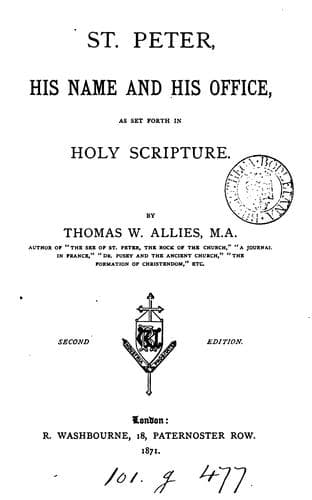
St. Peter, His Name and His Office, as Set Forth in Holy ScriptureAllies, T. W. (Thomas William)
Religion
St. Peter, His Name and His Office, as Set Forth in Holy Scripture
Allies, T. W. (Thomas William)
Peter, the Apostle, Saint
Our Lord tells us that He came upon earth to "finish a work;" and He
likewise tells us what that work was, the setting up a living
society of men, who should dwell in Him and He in them; on whom His
Spirit should rest, with whom His presence should abide, until the
consummation of all things. For, the evening before His passion,
"lifting up His eyes to heaven, He said: Father, the hour is come. *
* * I have glorified Thee on the earth: I have finished the work
which Thou gavest Me to do. * * I have manifested Thy name to the
men whom Thou hast given Me out of the world. Thine they were, and
to Me Thou gavest them; and they have kept Thy word. * Holy Father,
keep them in Thy name, whom Thou has given Me; that they may be one,
as We also are. While I was with them I kept them in Thy name.--And
now I come to Thee.--I pray not that Thou shouldest take them out of
the world, but that Thou shouldest keep them from evil. * * As Thou
hast sent me into the world, I also have sent them into the world.
And for them do I sanctify Myself, that they also may be sanctified
in truth. And not for them only do I pray, but for those also who
through their word shall believe in Me; that they all may be one, as
Thou, Father, in Me, and I in Thee; that they also may be one in Us;
that the world may believe that Thou hast sent Me. And the glory
which Thou hast given to Me, I have given to them, that they may be
one, as We also are one. I in them, and Thou in Me; that they may be
made perfect in one; and the world may know that Thou hast sent Me,
and hast loved them as Thou hast loved Me. * * And I have made known
Thy name to them, and will make it known; that the love wherewith
Thou hast loved Me may be in them, and I in them."[1]
In these terms the Eternal Word condescends to declare to us that
the fruit of His Incarnation, the "finished work" which His Father
had given Him to do, was the establishment of a society whose unity
in "truth" and "love" should be so perfect, that He exemplifies it
by the indwelling in each other of the Divine Persons; which should
be perpetual and visible for ever, so that the world by it and in it
should recognise His own mission, and believe in the Sender; and
that the dowry of this society, thus perpetually visible, should be
the equally perpetual possession of truth--the revelation of God's
will--and of love, which is conformity to it. And He based these
unexampled promises on no less a guarantee than the Almighty Power
and ineffable Goodness of His Father, witnessed by His own dwelling
amongst us in our flesh.
Elsewhere He termed this society His Church, declared that He
would [2]"build it on a rock, and that the gates of hell should not
prevail against it."
He told those whom He had set over it to go forth in His name, and
to teach all nations whatsoever He had commanded them, adding the
solemn engagement on His own part, [3]"Behold, I am with you all
days, even to the consummation of the world."
Public-domain text, read in full here on John Shaqi.
Reviews
Reviews
No reviews yet
Be the first to share your thoughts on this work.
Join the Discussion
Join the discussion
Sign in to leave a comment or review.
Sign InorCreate an account