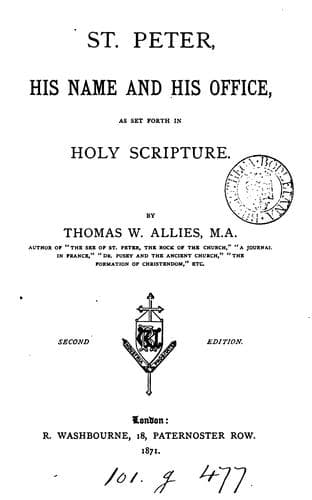
St. Peter, His Name and His Office, as Set Forth in Holy ScriptureAllies, T. W. (Thomas William)
Religion
St. Peter, His Name and His Office, as Set Forth in Holy Scripture
Allies, T. W. (Thomas William)
Peter, the Apostle, Saint
His whole teaching is full of reference to it, setting forth its
nature with every variety of illustration, enfolding it, as it were,
with an exuberance of divine charity.
But two conceptions run through every illustration, and are involved
in its primary idea, nay, as this was the finished work of His
Incarnation, so are they found in His adorable Person, from which
His work springs. These conceptions are Unity and Visibility.
As the mystery of the Incarnation consists in the union of the
divine and human natures, in one Person, and in the assumption of a
body, that is, matter, by the one uncreated, incomprehensible, and
invisible Being, whereby He becomes visible, so Unity and Visibility
are the unfailing marks of His Church, and enter into every image of
it, in such a manner that without them the image loses its point and
significancy.
Accordingly He proclaims the Church which He was founding to be "the
Kingdom of God," and "the Kingdom of Heaven," thus bringing before
us the conceptions of order, government, power, headship on the one
hand, dependence on the other, and a host of mutual relations
between the Sovereign and the people, significantly remarking that
"a kingdom which is divided against itself must fall." Now, a
kingdom without unity is a contradiction in terms, and a kingdom of
God on earth, which cannot be seen, would be for spirits and not for
men.
So He calls it a [4]"city seated on a mountain," which "cannot be
hid," answering to His prophet's words, "the city of the great
King," "His rest, and His habitation for ever." Here again are
embodied the notions of order, government, conspicuous majesty,
impregnable strength.
Thus He inspires His apostle to call it[ 5]"the house of God, the
pillar and ground of the truth." The house must have its head, the
family their father; the knowledge of that father's will is the
truth which rests upon the family as its support and pillar. Outside
of the family that knowledge may be lost, together with the will to
obey the father and to love him; but within it is a living
tradition, "familiar to the ear as household words." As long as the
Master and the Father is there, a perpetual light from His face is
there too upon His children and His servants. Divide the house, or
corrupt its internal life, and the idea of the house is destroyed;
while an invisible house is an absurdity.
Again, the Lord, calling Himself [6]"the Good Shepherd, who giveth
His life for the sheep," terms His Church the sheepfold, and
declares that as there is one shepherd, so there must be one fold.
But, rising yet in nearness to the Divine Person of the Word
Incarnate, from whose side sleeping on the cross she is moulded, the
Church is called His Spouse, as united to Him in eternal wedlock,
[7]"a great Sacrament," or mystery; and even yet more, His Body, as
supported by the continual influx of her Head; and all her members
are called "flesh of His flesh, and bone of His bones."
Public-domain text, read in full here on John Shaqi.
Reviews
Reviews
No reviews yet
Be the first to share your thoughts on this work.
Join the Discussion
Join the discussion
Sign in to leave a comment or review.
Sign InorCreate an account