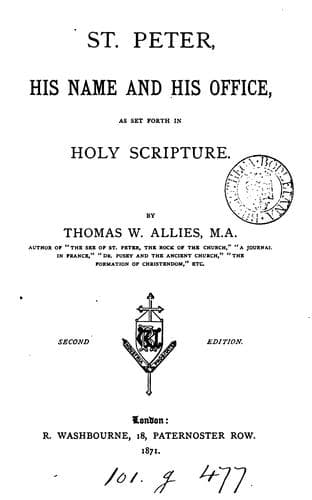
St. Peter, His Name and His Office, as Set Forth in Holy Scripture — John Shaqi
St. Peter, His Name and His Office, as Set Forth in Holy ScriptureAllies, T. W. (Thomas William)
Religion
St. Peter, His Name and His Office, as Set Forth in Holy Scripture
Allies, T. W. (Thomas William)
Peter, the Apostle, Saint
Just, then, as at a certain period of His ministry, our Lord, out
of the multitude who followed Him, selected twelve, to be His
special attendants upon earth, and, when He should be taken up, to
be the heralds of His Gospel among all nations, so out of the twelve
He from the beginning distinguished one, marked him out for a
peculiar and singular office, connected him with Himself in a
special manner, and after having through the whole of His ministry
given him tokens and intimations of his future destination, at last
expressly nominated him to take His own place, and preside among his
brethren. His dealing with this Apostle forms one connected whole,
in which there is nothing abrupt or inharmonious, out of keeping, or
opposed to what He said to others. What is at first obscurely
intimated is afterwards expressly promised, again in fresh terms
corroborated, and at last, in yet other language, but of the like
force, most significantly [12]conveyed, while it is attested by a
number of incidental notices scattered through the whole Gospel
history. Thus [13]it becomes necessary to consider each particular,
as well as the whole sum of things said, _proper_ and _peculiar_ to
this Apostle; to weigh first their _separate_ and then their _joint_
force, and only at last to form an united judgment upon all.
We are searching into the will of the Divine Founder of our faith,
which He has not only communicated to His Church in a living
tradition, but in this case likewise ordered to be set forth in
authentic written documents. These alone we are here considering,
and the point in question is whether He decreed that all the Twelve
should share equally in that divine mission and authority which He
had received from the Father, or whether while bestowing on them all
very high and distinctive powers, He yet appointed one, namely
Simon, the son of Jonas, to preside over the rest in His own place.
We have, then, to consider all in these documents which is said
peculiar to such apostle, pointing out singular gifts and
prerogatives, and carrying with it special authority of government.
And we must remember that where proofs are numerous and complex,
some which in themselves are only probable and accessory, yet have
their force on the ultimate result. But this result must be drawn
from a general view of the whole, and will collect in one the sum of
proof both probable and certain.
Again, where many various causes concur, some more and some less, to
produce a certain effect, the force of such effect is the force of
all these causes put together, not of each by itself alone. Or where
many witnesses are examined, whose evidence differs in value,
although the testimony of some be in itself decisive, yet the
verdict must be given after a consideration and review of all.
Public-domain text, read in full here on John Shaqi.
Reviews
Reviews
No reviews yet
Be the first to share your thoughts on this work.
Join the Discussion
Join the discussion
Sign in to leave a comment or review.
Sign InorCreate an account