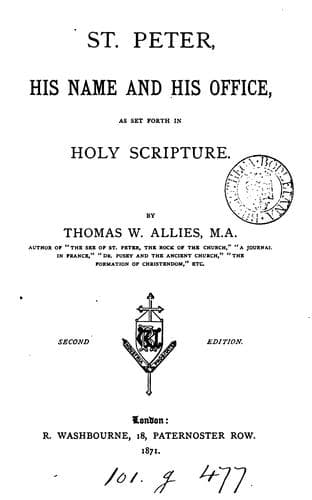
St. Peter, His Name and His Office, as Set Forth in Holy ScriptureAllies, T. W. (Thomas William)
Religion
St. Peter, His Name and His Office, as Set Forth in Holy Scripture
Allies, T. W. (Thomas William)
Peter, the Apostle, Saint
4. And these words bring us to the fourth unity mentioned by our
Lord. For not until "He ascended up on high" did "He give gifts to
men." And this visible hierarchy, the sign and token of His mystical
Headship, and fostering care, is by Him quickened and informed with
the Holy Spirit, when He is Himself invisible at the right hand of
the majesty of God. This absence, too, is what He foretold, saying,
"And now I am not in the world, and these are in the world, and I
come to thee; Holy Father, keep them in Thy name whom Thou hast
given Me; that they may be one, as we also are. While I was with
them, I kept them in Thy name.--And now I come to Thee."--These
words of our Lord show that it was His will that His believers
should be no less one among each other, by an outward and visible
union, than they were one by the internal bond of charity, the
guidance of one Spirit of truth, and the influx of the one Vine. And
so far we have seen that, to guard and maintain that unity under the
guidance of the Spirit of truth, He called forth the visible
hierarchy, in all its degrees. But what, then, was the external root
and efficient principle of this visible hierarchy, when He was gone
to the Father? Did He not likewise provide for the loss occasioned
by His own absence, which He had foretold? The argument of S. Paul
proves that He did so provide, as well as His own words. For S. Paul
declares the Church to be "one Body." Was it then a body without a
head, or a body with a head invisible? Or did the Lord of all,
having with complete wisdom framed His mystical body in all its
parts and proportions, and having set _first_ Apostles, and then in
their various degree, doctors and pastors, in one single, and that
the main point, reverse the analogy of all His doings? Did He
appoint every officer in His household, except the one who should
rule all? Did He construct the entire arch, save only the keystone?
Did He make a bishop to represent His person, and be the centre of
visible unity in every diocese, but none to represent that person in
the highest degree and to be the centre of unity to the whole
Church? Was it the end of His whole design "to gather together in
one the children of God, that were dispersed," in order that there
might be "One Fold," and did He fail to add, "One Shepherd?" Yet S.
Paul declares that "there are many members, but one body." How can
the distinct and diverse members be reduced to the unity of a body,
but by the unity of the head, as the efficient principle? In
accordance with which we may observe that never is the image of a
body used in Scripture to represent the Church, but it is thereby
shown to be visible; and never is it compared with a body as a type,
but that body is shown complete with its head. Such are the
well-known images of one House, Kingdom, City, Fold, and Temple, to
which we have had so often to appeal. Even the unity of things in
themselves dissimilar is derived in Scripture from the unity of the
Head.
Public-domain text, read in full here on John Shaqi.
Reviews
Reviews
No reviews yet
Be the first to share your thoughts on this work.
Elsewhere in the archive
Join the Discussion
Join the discussion
Sign in to leave a comment or review.
Sign InorCreate an account