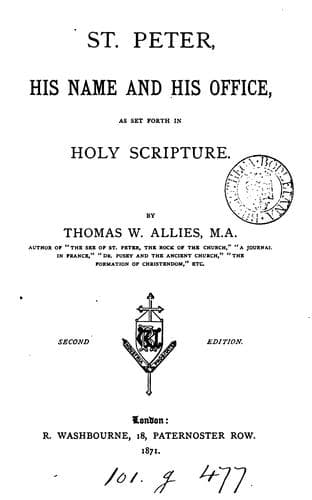
St. Peter, His Name and His Office, as Set Forth in Holy ScriptureAllies, T. W. (Thomas William)
Religion
St. Peter, His Name and His Office, as Set Forth in Holy Scripture
Allies, T. W. (Thomas William)
Peter, the Apostle, Saint
Thus the man and the woman are said in marriage to be one, and
that in a great mystery, representing Christ and the Church, but
this, because "the husband is the head of the wife." And Christ is
said to be one with the faithful, because "the head of every man is
Christ:" and God one with Christ, because "the head of Christ is
God." If, then,[26] the Church is one body, it receives, according
to the reasoning of Holy Scripture, that property from the unity of
its head.
But such a one body, while yet militant upon earth, S. Paul declares
it to be, setting forth at the same time the various orders of its
hierarchy. Is it then a body complete, or incomplete? With a head or
without one? For it is no reply to say that it has indeed a head,
but one invisible. That invisible headship did not obviate, as we
have seen, the necessity of a visible hierarchy: why then does it
obviate the like and even more striking necessity, that the
hierarchy too must have its visible head? If it was, so to say, the
very first act of our Lord's supreme headship over all to the
Church--the very token that He had led captivity captive--to quicken
the visible ministry which He had established by sending down the
Holy Spirit to abide with it for ever, is the one place most
necessary in that ministry to be the only one left vacant by Him? Is
the one officer most fully representing Himself to be alone omitted?
"The _perfecting_ of the saints" (a metaphor taken as we have seen,
from the exact fitting together of the stones in a building,) and
"the edifying of the body of Christ," are described as the end to be
reached by those to whom "the work of the ministry" is committed,
but as this applies in a higher degree to the Bishop than to the
priest, so it applies in the highest of all to the Bishop of
bishops.
Again, God's method of teaching by symbols, which runs through the
whole Scripture, and the institution of Sacraments, proves to us His
will to lead us on from the visible to the invisible, and to make
the former a channel to the latter. For "we are all baptized into
one body," and the outward act both images and conveys the inward
privilege. And again in the highest conceivable instance, "because
the head is one, we being many are one body, who all partake of
that one bread."[27] In like manner the outward unity of the Church
must accurately represent, and answer to the inward, which, we know,
is derived from the Person of Christ, who is its head. And so that
Person must be specially represented in the outward unity.
Public-domain text, read in full here on John Shaqi.
Reviews
Reviews
No reviews yet
Be the first to share your thoughts on this work.
Elsewhere in the archive
Join the Discussion
Join the discussion
Sign in to leave a comment or review.
Sign InorCreate an account