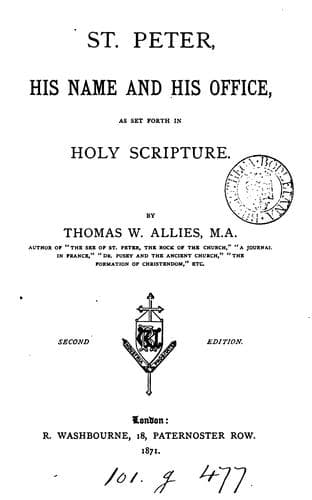
St. Peter, His Name and His Office, as Set Forth in Holy ScriptureAllies, T. W. (Thomas William)
Religion
St. Peter, His Name and His Office, as Set Forth in Holy Scripture
Allies, T. W. (Thomas William)
Peter, the Apostle, Saint
And this is one reason why no unity of a college, whether of
Apostles, or of Bishops, will adequately express that visible
headship of which our Lord's Person is the exemplar. For the root of
all lies in a personal unity, that of the Godhead and Manhood, and
therefore a merely collective or representative unity cannot express
it. And if the Apostle wrote, "God hath set in the Church _first_
Apostles," yet he also wrote that the grand result, "the perfecting
of the saints, and the edifying of the body of Christ," was due to
the ministry, not only of Apostles, but of prophets, evangelists,
pastors, and doctors, each in their degree; they all conspire to a
joint action, which does not impede the existence of distinct orders
in the hierarchy. And his expression that the Apostles are _first_
in this hierarchy, without defining their mutual relations to each
other, does not exclude those other passages of Scripture which _do_
define those relations, and which make Peter among the Apostles "the
first," "the ruler," "the greater," the Judah among his brethren,
the foundation of the whole building, and the one shepherd in the
universal fold. And the more so because S. Paul uses three
expressions of the Church, two of which are _relative_, but one
_absolute_. He calls it "the body of Christ," and "Christ," which
are relative; but he also calls it "one body," which is absolute.
Now, these expressions are not to be severed from each other, as if
each by itself would convey the whole idea of the Church, which
rather is to be drawn from them all together. In answer to what the
Church is, we must not say that it is _either_ "the body of Christ,"
_or_ mystically called "Christ," _or_ set before us as "one body,"
for it is _all_ of these at once, relatively "Christ," and "the body
of Christ," and absolutely "one body."
As, then, the former expressions show that the Church is one _in
reference to Christ_, so the latter shows that it is so _in itself_,
and _simply_. For as the Church is called "Christ," and "the Body of
Christ," because it is one with Christ by mystical union, drawing
its supernatural life from Christ its head, so it is called "one
body," because in the variety of members and parts, of which it
consists, no one is wanting to its being one body in itself, and to
its being seen to be such. But it would neither be so, nor seem to
be so, if it were without a visible head, the origin and principle
of its inherent visible unity. And so where the Church is called by
S. Paul "one Body," he declares that it has a visible head.
Public-domain text, read in full here on John Shaqi.
Reviews
Reviews
No reviews yet
Be the first to share your thoughts on this work.
Elsewhere in the archive
Join the Discussion
Join the discussion
Sign in to leave a comment or review.
Sign InorCreate an account