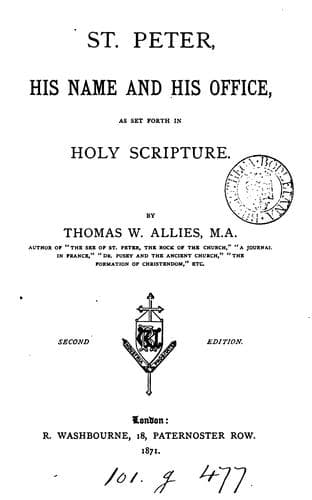
St. Peter, His Name and His Office, as Set Forth in Holy ScriptureAllies, T. W. (Thomas William)
Religion
St. Peter, His Name and His Office, as Set Forth in Holy Scripture
Allies, T. W. (Thomas William)
Peter, the Apostle, Saint
Thus it is that the inherent notion of the Church, as one visible
body, and the whole dispensation by which visible things answer to
invisible, as their archetypes, demand one visible head. Now to this
_inherent_ necessity let us add the force of _positive_ teaching.
When our Lord in almost His last words to His Church prays to His
Father, "while I was with them in the world, I kept them in Thy
name--but now I come to Thee," what does He but suggest the
appointment of another visible head to take that place which He was
leaving? and further, what does He but name one to that high
dignity, when He calls him "the greater" and "the ruler" among his
brethren, commits them to him to be confirmed by him, and makes him
the shepherd of the whole flock? What else had He done but prepare
them for such a nomination, when He promised _one_ that he should
be the foundation of His Church, and the bearer of the keys? What
else did Christians from the beginning see in such an one, when they
called him the _head_, the _centre_, the _fountain_, the _root_, the
_principle_ of ecclesiastical unity?
Let us remark, once more, as a confirmation of the above, that the
archetype of visible unity in the Church, which our Lord sets before
us in His prayer to the Father, is no other than that most high and
solemn of all things conceivable, the mutual indwelling of the
Father and the Son. "Holy Father, keep them in Thy name whom Thou
hast given Me, that they may be one, as We also are;" and again, for
all successive generations of the faithful, "that they all may be
one, as Thou, Father, art in Me, and I in Thee, that they also may
be one in Us, that the world may believe that Thou hast sent Me."
Now the relation established by our Lord between Peter and the rest
of the Apostles, by appointing him the visible head of the Church,
and between Peter's successor and all bishops, does represent, so
far as earthly things may, and in a degree which nothing else on
earth reaches to, the mutual relation of the three divine Persons to
each other. For as these are distinct, but inseparable, so, too, are
the Apostles. As the fulness of the Godhead is _first_ in the Father
and _then_ in the Son and in the Holy Spirit, so the fulness of
power _first_ promised and given to Peter, is _then_ propagated to
the other Apostles united with him. As in the Father the economy of
the divine Persons is summed up under one head, and gathered into a
monarchy, so in Peter is gathered up the fulness of ecclesiastical
power, which, through union with him, is one in all, as the Church
is one, and the Episcopate one. Moreover, as it is the dignity of
the Father to be the exemplar, principle, root, and fountain of
unity in the Trinity, so is it the dignity of Peter to be the
exemplar, principle, root, and fountain of visible unity in the
kingdom of God, which is the Church. This is alluded to by Pope
Symmachus, thirteen hundred and fifty years ago: "There is one
Public-domain text, read in full here on John Shaqi.
Reviews
Reviews
No reviews yet
Be the first to share your thoughts on this work.
Elsewhere in the archive
Join the Discussion
Join the discussion
Sign in to leave a comment or review.
Sign InorCreate an account