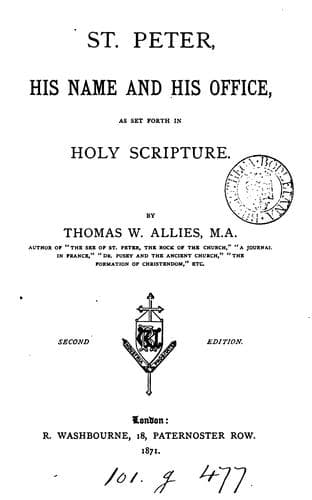
St. Peter, His Name and His Office, as Set Forth in Holy ScriptureAllies, T. W. (Thomas William)
Religion
St. Peter, His Name and His Office, as Set Forth in Holy Scripture
Allies, T. W. (Thomas William)
Peter, the Apostle, Saint
single priesthood in the different prelates, (of the Apostolic See)
after the example of the Trinity, whose power is one and
indivisible."[28] And long before him S. Cyprian: "The Lord says, 'I
and the Father are one.' And again it is written of the Father and
the Son and the Holy Spirit, 'And these three are one.' Is there a
man who believes that this unity, coming from the divine solidity,
cohering by heavenly sacraments, can possibly be broken in the
Church, and torn asunder by the collision of adverse wills? This
unity he who holds not, holds not the law of God, holds not the
faith of the Father and the Son, holds not the truth unto
salvation."[29]
Whereas, then, all unity in the Body of Christ, the Church, is
derived ultimately from the person of its Head, the Word Incarnate,
that unity is yet four-fold in its operation, and the efficient
principle of one sort is not to be confounded with that of another.
There is the _mystical_ unity, which consists in the perpetual
divine influx from the great invisible Head to His members; there is
the _moral_ or _spiritual_ unity of charity, consisting in the
presence of the Holy Spirit in the hearts of believers, and these
two are internal, and in closest correspondence. There are two
likewise external, which may be called the _civil_ or _political_
unity, consisting in the public profession of the same faith, the
same truth, for what the _law_ is to temporal states, the _faith_ is
to the great spiritual kingdom of Christ; and this unity is indeed
inspired by the Holy Spirit, but is maintained by Him through the
visible hierarchy; and lastly, correspondent to the unity of faith,
there is the _visible_ unity of external organization, the immediate
or efficient principle of which lies in the visible headship over
the Church attached by the Lord to S. Peter's chair. The latter two,
while they correspond to each other, are indeed subordinate to the
former, the unity of faith to that of charity, as the unity of the
visible headship to that of the invisible; yet the very truth of the
Body which the Lord has assumed, and in which He reigns, and the
whole analogy of His dealings with men, and the sacraments whereby
He makes us "partakers of the divine nature," warn us that it is of
the highest importance for us to see how external unity is the
channel of internal, and the visible the road to the invisible. No
words can be more emphatic to this effect than those with which the
Apostle introduces the description of the visible hierarchy, and the
divine headship which called it forth. "There is _one Body_ and one
Spirit, as you are called in one hope of your calling. One Lord, one
faith, one baptism. One God and Father of all, who is above all, and
through all, and in us all." From which he goes on to say,
"Ascending up on high, He gave gifts to men--some Apostles, and some
prophets, and some evangelists, and some pastors, and teachers." And
lastly, "the Head over all things to the Church," is "the Saviour
Public-domain text, read in full here on John Shaqi.
Reviews
Reviews
No reviews yet
Be the first to share your thoughts on this work.
Elsewhere in the archive
Join the Discussion
Join the discussion
Sign in to leave a comment or review.
Sign InorCreate an account