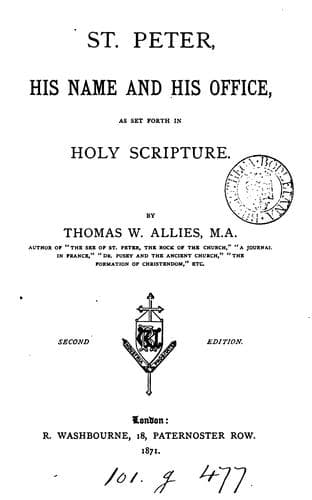
St. Peter, His Name and His Office, as Set Forth in Holy ScriptureAllies, T. W. (Thomas William)
Religion
St. Peter, His Name and His Office, as Set Forth in Holy Scripture
Allies, T. W. (Thomas William)
Peter, the Apostle, Saint
pre-ordained end, its proper character and very lineaments, the
Primacy itself is included, and exhibited as the principal cause
which effects the unity of the whole body? I hardly think that any
such can be, so apparent is the bond which ties these several parts
together.
Yet perhaps this may be more vividly brought out if we shortly
mention the common opinions among Protestants on the Church's unity.
For, omitting those who hold an[45] invisible Church, and so expunge
visible unity from its attributes, all the other opinions may be
reduced to three.
A. Anglicans, whose belief has been set forth, besides Pearson on
the Creed, with more than usual care by Dodwell, (in his Treatise on
the Bishop, as the Principle of Unity, and S. Peter's Primacy among
the Apostles as the Exemplar of Unity,) begin by noting that the
question of visible unity cannot be determined in the same way as it
respects the universal Church, or each particular Church. But why?
Because, they say, it was indeed the will of Christ, that each
particular Church should have a double unity, inward and outward,
but it was not His will that the whole Church, the sum of these
particular Churches, should have the same mark and test. Because, it
was His will that both unities should characterise the particular
Churches, to use a school phrase, _separately_ and _distributively_,
but not the whole body, and the sum of these, taken _collectively_.
Whence they conclude that Bishops were chosen and made, by the
command of Christ, to preside over particular Churches, and be in
them the source and principle of external unity, but that a Primate
was not chosen, to whom the whole Church should be subject, and on
whom its external unity should depend.
At this argument one is lost in astonishment, how it could have
suggested itself to learned men, and gained their assent. For what
had they to prove, or how could they assure themselves, or others,
as to either of these two points, that external unity was necessary
to particular Churches, but not to the whole Church, or that the
institution of Bishops, presiding over particular Churches, came
from Christ, but not that of the Primate, whose charge was to rule,
administer, and maintain in unity the whole Church. Had they texts
wherein to trust? But as often as the Bible speaks of the Church's
unity, it means that Church, which is called "the kingdom of God,"
"the kingdom of Christ," and "the kingdom of heaven," which is
termed "the inheritance of the Gentiles," and embraces with a
mother's bosom, and a mother's love, the whole race of man, from one
end of the earth to the other. Had they creeds to cite? But in these
unity is attributed to that Church only, which is so termed
absolutely, and very often has the epithet of Catholic.
Public-domain text, read in full here on John Shaqi.
Reviews
Reviews
No reviews yet
Be the first to share your thoughts on this work.
Elsewhere in the archive
Join the Discussion
Join the discussion
Sign in to leave a comment or review.
Sign InorCreate an account