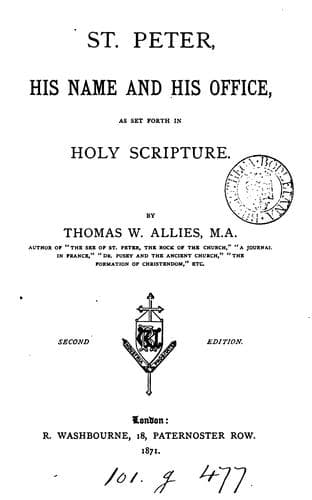
St. Peter, His Name and His Office, as Set Forth in Holy ScriptureAllies, T. W. (Thomas William)
Religion
St. Peter, His Name and His Office, as Set Forth in Holy Scripture
Allies, T. W. (Thomas William)
Peter, the Apostle, Saint
Moreover, is the word Church, in its unrestricted application, of
doubtful meaning? On the contrary, it is specially defined as well
in the Holy Scriptures,[46] where it expresses of itself the whole
society of believers, as in the Fathers, such as Irenaeus,[47]
Tertullian,[48] Clement[49] of Alexandria, Origen,[50] Hilary,[51]
Jerome,[52] and all the rest without exception, who, in using it,
express the whole Christian people joined in one sole communion. It
is defined also by Councils, as in the Canons of Laodicea,[53]
Carthage,[54] and Constantinople,[55] where the Church means the
whole assembly of orthodox believers, as distinct from heretics and
schismatics. It is defined in the most ancient explanation of the
creeds, the unanimous meaning of which Tertullian seems to have
rendered in saying: "And, therefore, so many and so great Churches
are that first one from the Apostles, whence all come. So all are
first, and all Apostolical, while all set forth one unity, while
they have interchange of peace, the appellation of brotherhood and
the common rights of friendship, privileges regulated by no other
principle than the tradition of the same sacrament."[56] Lastly, the
very heretics[57] defined this term, who, in order to make
themselves understood, could use the word Church in no other sense
than to express the universal assembly of the faithful.
After this it is not at all necessary to ask Anglicans afresh if
they have ancient Fathers whose authority they can quote. What these
thought and believed about the Church's unity is fully shown by
those whom we have quoted, and by the words of Irenaeus, "The Church,
though dispersed throughout the whole world, yet as if it were
contained in the same house, carefully preserves the rule of faith,
and holds it as if she had one soul and one heart, nay, and teaches
it with one consent, as if she spoke with one voice. For although
different tongues occupy the world, yet the force of tradition is
one and the same, nor do the Churches of Germany, Spain, Gaul, the
East, Egypt, Libya, and the middle of the world, embrace any other
faith. But as there is one and the same sun shining over the whole
world, so the preaching of the truth shines everywhere, and
enlightens all men who desire its knowledge."[58]
Public-domain text, read in full here on John Shaqi.
Reviews
Reviews
No reviews yet
Be the first to share your thoughts on this work.
Elsewhere in the archive
Join the Discussion
Join the discussion
Sign in to leave a comment or review.
Sign InorCreate an account