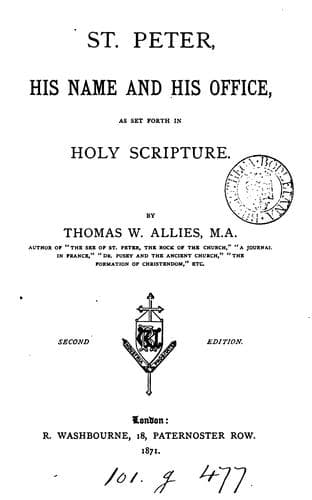
St. Peter, His Name and His Office, as Set Forth in Holy Scripture — John Shaqi
St. Peter, His Name and His Office, as Set Forth in Holy ScriptureAllies, T. W. (Thomas William)
Religion
St. Peter, His Name and His Office, as Set Forth in Holy Scripture
Allies, T. W. (Thomas William)
Peter, the Apostle, Saint
Now just in the same manner is Peter the Rock of the Church, and the
cause next to Christ of that firmness with which the Church shall
remain impregnable to the end. For therefore is he the Rock and
Foundation of the Church, because he has been called into a sort of
unity with Him of whom it is said, "Behold I lay in Sion a chief
corner stone, elect, precious, and he that believeth on it shall not
be ashamed:" and in whom, as Paul explains, "the whole building
fitly framed together increaseth unto a holy temple in the
Lord."[59] Therefore is he the Church's Rock, because as he, by his
own confession, declared the Godhead of the Foundation in chief,
"Thou art the Christ, the Son of the living God," so from Him, who
is the chief and substantial Foundation, he received the gift of
being made partner in one and the same property: "And I too say unto
thee, that thou art Peter, and upon this rock I will build my
Church;" one with Me by communication of My office and charge, My
dignity and excellency. Hence the stability of Peter is that of
Christ, as the splendour of the ray is that of the sun; Peter's
dignity that of Christ, as the river's abundance is the abundance of
the fountain. Those who diminish Peter's dignity may well be charged
with violating the majesty of Christ; those who are hostile to
Peter, and divorced from him, stand in the like opposition to
Christ.
Now this parallel is an answer[60] to those who object to Peter's
supereminence as the Foundation, that this dignity is entirely
divine, surpassing by an almost infinite degree the capacity of man.
For is not that a divine dignity which consists in the paternity of
all the faithful? Is not that prerogative beyond man's capacity by
which one becomes the author of a blessing diffused through all
nations? Yet no one denies that such a dignity and such a
prerogative were granted to Abraham. In divine endowments,
therefore, their _full_ and _natural possession_ must be carefully
distinguished from their _limited_ and _analogous participation_.
The one, as inherent, cannot fall to the creature's lot; the other,
as transferable, may be granted as God pleases. For what further
removed from man than the Godhead? Yet it is written, "I have said,
ye are Gods."[61]
Public-domain text, read in full here on John Shaqi.
Reviews
Reviews
No reviews yet
Be the first to share your thoughts on this work.
Join the Discussion
Join the discussion
Sign in to leave a comment or review.
Sign InorCreate an account