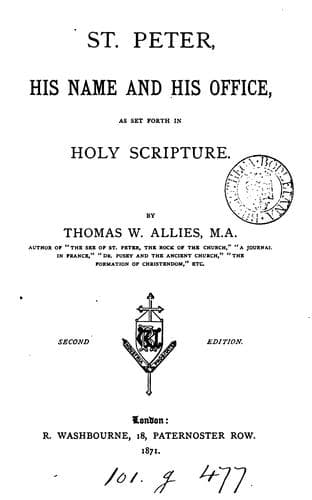
St. Peter, His Name and His Office, as Set Forth in Holy ScriptureAllies, T. W. (Thomas William)
Religion
St. Peter, His Name and His Office, as Set Forth in Holy Scripture
Allies, T. W. (Thomas William)
Peter, the Apostle, Saint
Not weightier is the other objection, that the office of being the
Foundation is too important to be entrusted to human care. Was there
less difficulty in blessing being diffused from one man among all
nations? Rather we must look on man not as he is by, and of,
himself, apart from God, and left to his own weakness, but as
upborne by divine power, according to the promise, "Behold, I am
with you all days, until the consummation of the world." Who can
doubt that man, in union with God, may serve for a foundation, and
discharge those offices in which the unity of a structure consists?
It is confidently and constantly objected, that "other foundation no
man can lay beside that which is laid, which is Jesus Christ."[62]
As if what has been laid by Christ Himself, and consists in the
virtue of Christ alone, can be thought other than Christ; or as if
it were unusual, or unscriptural, for things proper to Christ to be
participated by men. Therefore the chief difficulties against
Peter's pre-eminence, and character as the Foundation, seem to
spring from the mind failing to realise the supernatural order
instituted by God, and the perpetual presence of Christ watching
over His Church.
Thus it is no derogation to Abraham's being the Father of the
faithful, or to the hierarchy of the Church instituted by Christ
Himself, that our Lord says,[63] "Call none your father upon earth,
for one is your Father who is in heaven;" inasmuch as Scripture
abundantly proves that divine gifts are richly conferred upon men.
What more divine than the Holy Spirit? Yet it is written,[64] "And I
will ask the Father, and He shall give you another Paraclete, that
He may abide with you for ever." What a higher privilege than filial
adoption? Yet it is said, [65]"Ye have received the spirit of filial
adoption, by which we cry, Abba Father." What a greater treasure
than co-inheritance with Christ? Yet we read, [66]"but if children,
also heirs: heirs of God, but joint heirs with Christ." What higher
than the vision of God? Yet S. Paul bears witness, [67]"We see now
through a glass darkly, but then face to face." What more wonderful
than the power of remitting sins? Yet this very power is granted to
the Apostles, [68]"Whose sins you shall forgive, they are forgiven
them." What further from human weakness than the power of working
miracles? Yet Christ establishes this, [69]"Amen, amen, I say unto
you, he that believeth on Me, the works which I do, shall he do
also, and greater works than these shall he do." Indeed, the
participation and communion of heavenly gifts have the closest
coherence with that supernatural order, which God in creating man
chose, and to which He called fallen man back through His only
begotten Son; with that dispensation of Christ by which He loved the
Apostles as He Himself was loved by the Father, by which He called
them, [70]"not servants, but friends," and gave them that glory
which He had Himself received from the Father. And the tone of mind
Public-domain text, read in full here on John Shaqi.
Reviews
Reviews
No reviews yet
Be the first to share your thoughts on this work.
Join the Discussion
Join the discussion
Sign in to leave a comment or review.
Sign InorCreate an account