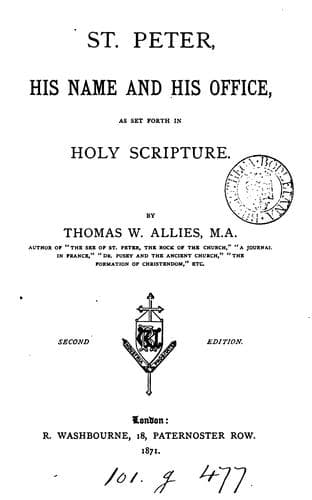
St. Peter, His Name and His Office, as Set Forth in Holy ScriptureAllies, T. W. (Thomas William)
Religion
St. Peter, His Name and His Office, as Set Forth in Holy Scripture
Allies, T. W. (Thomas William)
Peter, the Apostle, Saint
which denies Peter's prerogative as the Foundation of the Church,
under pretence that it is an usurpation of divine power, tends to
deny some one or all of the privileges just cited, and, as a fact,
does deny some of them. It is [71]wonderful to see how only common
and vulgar things are discerned by modern eyes, where the Fathers
saw celestial and divine gifts. Those without the Church have fallen
away as well from the several parts and privileges, from what may be
called the standing order, of the Incarnation, as from its final
purpose and scope; and it is much if they would not charge with
blasphemy that glorious saying put forth by the greatest of the
Eastern, as by the greatest of the Western Fathers, "that God became
man, in order that man might become God."[72]
Was, then, S. Chrysostome wrong when he said that our Lord, in that
passage of Matthew, showed a power equal to God the Father by the
gifts which He bestowed on a poor fisherman? "He who gave to him the
keys of the heavens, and made him Lord of such power, and needed not
prayer for this, for He did not then say, I prayed, but, with
authority, I will build my Church, and I will give to thee the keys
of heaven."[73] Was he wrong when he called him "the chosen of the
Apostles, the mouth-piece of the disciples, the head of the band,
the ruler over the brethren?"[74] Or where he saw these prerogatives
in the very name of Peter, observing, "When I say Peter, I mean the
impregnable rock, the immovable foundation, the great apostle, the
first of the disciples?"[75]
To sum up, then, what has been hitherto said, we have advanced so
far as this; first the promise, and then the bestowal of a new name,
expressing a singular pre-eminence, and in its _proper_ sense
befitting Christ alone, have distinguished Simon from the rest of
the apostles. But much more the power signified by that name, and
explained by the Lord Himself, carries far higher Peter's privilege,
and indicates him to be the possessor of authority over the
Apostles. For if Simon is the Rock of the Church, and if the
property of Foundation, on which the structure of the Church rests,
belongs to him immediately after Christ, and analogously with
Christ, there arises this relation between Christ and Simon, that as
He is first, and chiefly, and by inherent power, so Simon is
secondarily, by participation and analogy, that which underlies,
holds together, and supports the Apostles and the whole fabric of
the Church.
Public-domain text, read in full here on John Shaqi.
Reviews
Reviews
No reviews yet
Be the first to share your thoughts on this work.
Join the Discussion
Join the discussion
Sign in to leave a comment or review.
Sign InorCreate an account