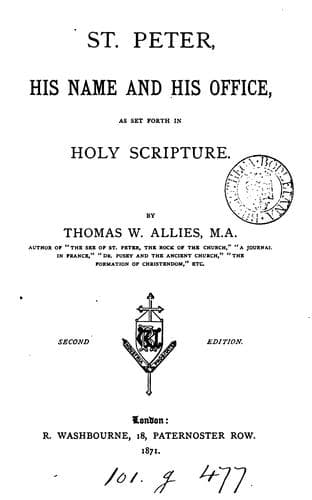
St. Peter, His Name and His Office, as Set Forth in Holy Scripture — John Shaqi
St. Peter, His Name and His Office, as Set Forth in Holy ScriptureAllies, T. W. (Thomas William)
Religion
St. Peter, His Name and His Office, as Set Forth in Holy Scripture
Allies, T. W. (Thomas William)
Peter, the Apostle, Saint
Now, innumerable as are the particulars in which the Christian
revelation consists, they may yet be gathered up mainly into two
points, which meet in the Person of our Lord, and are termed by the
ancient fathers who have followed this division, the _Theology_, and
the _Economy_. There is the Divine Nature, that "_form of God_,"
which our Lord had from the beginning in the bosom of the Father;
and there is the human nature, that "_form of a servant_," which "in
the economy or dispensation of the fulness of times" He assumed, in
order that He might purchase the Church with His blood, and[2]
"re-establish all things in heaven and on earth." All, therefore,
in the Christian faith which concerns "the form of God" is termed
the Theology; all which contemplates "_the form of a servant_," the
Economy.
But the heavenly origin and certain truth of both these parts of
Christian faith are proved partly by the fulfilment of prophecy, and
partly by the working of miracles. To both our Lord perpetually
appealed, and His apostles after Him, and those who have followed
them. One, then, who was to be the chief ruler and doctor of
Christians, needed especial instruction in the Theology, and
Economy, especial assurance of the fulfilment of prophecy, and the
working of miraculous power. Now Peter was specially selected for
this instruction and that assurance.
The whole teaching of our Lord, indeed, and the innumerable acts of
power and words of grace with which it was fraught, were calculated
to convey these to all the Apostles. But while they were witnesses
in common of that teaching in general, some parts of it were
disclosed only to Peter and the two sons of Zebedy. Perhaps there is
no incident in the Gospel history, which set forth in so lively a
manner, and so convincingly proved, the mysteries concerning the
union of "the form of God" and "the form of a servant," as the
Transfiguration. The retreat to the "high mountain apart," and in
the midst of that solitary prayer, "the face shining as the sun,"
and "the robes white as light," the presence of Moses and Elias,
conversing with Him on the great sacrifice for sin, "the bright
cloud which encompassed them," and the voice from out of it,
proclaiming "This is my beloved Son, in whom I am well pleased: hear
Him;" so impressed themselves on the great Apostle, that after long
years he appealed to them in proof that he and his brethren had not
taught "cunningly devised fables, when they made known the power
and presence of the Lord Jesus Christ, but had been eyewitnesses of
His majesty, when He received from God the Father honour and glory,
this voice coming down to Him from the excellent glory, 'This is my
beloved Son, in whom I have pleased myself: hear ye Him.' And this
voice we heard brought from heaven, when we were with Him in the
holy mount." Among all the Apostle's experience of the three years'
ministry, by the shore and on the waves of the lake of Galilee, in
Public-domain text, read in full here on John Shaqi.
Reviews
Reviews
No reviews yet
Be the first to share your thoughts on this work.
Join the Discussion
Join the discussion
Sign in to leave a comment or review.
Sign InorCreate an account