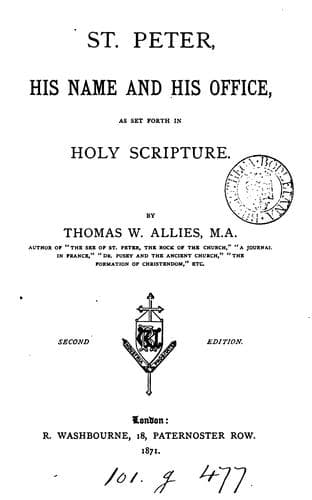
St. Peter, His Name and His Office, as Set Forth in Holy ScriptureAllies, T. W. (Thomas William)
Religion
St. Peter, His Name and His Office, as Set Forth in Holy Scripture
Allies, T. W. (Thomas William)
Peter, the Apostle, Saint
But, 4, what does our Lord censure and reject from His Church? It is
plain that He compares kingdom with kingdom, and the kingdom of
heaven, which is the Church, with human kingdoms, and, moreover,
that the negative quality as to which, in the clause, "But you not
so," the two are compared, is, _not_ the fact that there is
pre-eminence and rule in both, but a certain _mode_ of exercising
them. This is, the pomp and ambition expressed in the words,
"lording it," "exercising authority," "are called benificent." As
again is shewn in the repeated declaration that what had been most
alien from the spirit of His own ministry, should not appear in the
ministry that He would establish after Him. Now He had shown no pomp
and pride of dominion, but yet He had shown the dominion itself in
the fullest sense, the power of passing laws, enjoining precepts,
defining rites, threatening punishments, governing, in fine, His
Church, so that He had been pre-eminently "the Lord." Lastly, this
is shown in the words recorded by S. John, as said shortly after on
this same occasion. "You call Me Master and Lord, and you say well,
for so I am. If I then, your Lord and Master, have washed your feet,
you also ought to wash one another's feet: _for I have given you an
example_, that as I have done unto you, so you also may do."[22]
Now nothing can show more strongly than this discourse the
pre-eminence and authority which our Lord was going to establish in
one of His Apostles over the rest. For here we have His intention
disclosed that in His kingdom, which is the Church's, some one there
should be "the Great," "the First," and "the Ruler," who should
discharge, in due proportion and analogy, the office which He
Himself, before He returned to the Father, had held. But before we
consider further who this one was, let us look at the subject from a
somewhat different point of view.
And [23]here we must lay down three points, the _first_ of which is,
that our Lord, during His life on earth, had acted in two
capacities, the one, as the Author and Founder, the other, as the
Head and Supreme Ruler of His Church. His functions in the former
capacity are too plain to need enlarging upon. He disclosed the
objects of our faith: He instituted rites and sacraments: He
provided by the establishment of a ministry for the perpetual growth
and duration of the Church. It was in this sense that He spoke of
Himself to His apostles, as "the Master," who could share His
prerogatives with no one: "But be not you called Rabbi, for one is
your Master, and all you are brethren."[24] Thus is He, "the
Teacher," "the Master," throughout the Gospel.
Public-domain text, read in full here on John Shaqi.
Reviews
Reviews
No reviews yet
Be the first to share your thoughts on this work.
Join the Discussion
Join the discussion
Sign in to leave a comment or review.
Sign InorCreate an account