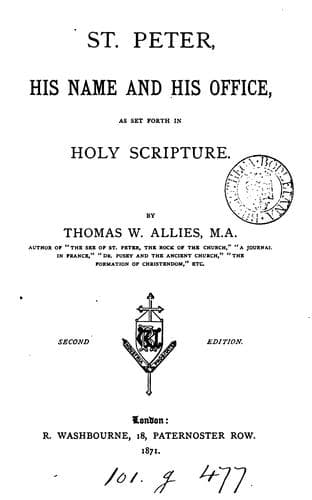
St. Peter, His Name and His Office, as Set Forth in Holy ScriptureAllies, T. W. (Thomas William)
Religion
St. Peter, His Name and His Office, as Set Forth in Holy Scripture
Allies, T. W. (Thomas William)
Peter, the Apostle, Saint
But He likewise acted as the Head of His Church, with the dignity
and authority of the chief visible Ruler. He was the living bond of
His disciples: the person around whom they grouped: whose presence
wrought harmony: whose voice terminated contention among them: who
was ever at hand to solve emergent difficulties. Thus it is that
prophecy distinguished Him as "the Lord," "the King," "the
Shepherd;" "on whose shoulders is the government," "who should
_rule_ His people, Israel." And His Church answers to Him in this
capacity, as the family, the house, the city, the fold, and the
kingdom.
Thus His relation to the Church was twofold, as Founder, and as
Supreme Pastor.
_Secondly_, the Church shares her Lord's prerogative of
unchangeableness, and as He is "Jesus Christ the same yesterday,
to-day, and for ever," so She, His mystical Body, in her proportion,
remains like herself from the beginning to the end. The Church and
Christianity are bound to each other in a mutual relation; the
Church is Christianity embodied; Christianity is the Church in
conception: the consistency and identity which belong to
Christianity belong likewise to her; neither can change their
nature, nor put on another form.
But, _thirdly_, the Church would be unlike herself, if, having been
from her very cradle visibly administered by the rule of One, she
fell subsequently, either under no rule at all, according to the
doctrine of the Independents, or under the rule of the multitude,
according to the Calvinists, or under the rule of an aristocracy, as
Episcopalians imagine. A change of government superinduces a change
of that substantial form which constitutes a society. But this holds
in her case especially, above all other societies, as she came forth
from the creative hand of her Lord, her whole organization instinct
with inward life, her government _directly_ instituted by God
Himself, in which lies her point of distinction from all temporal
polities.
Public-domain text, read in full here on John Shaqi.
Reviews
Reviews
No reviews yet
Be the first to share your thoughts on this work.
Join the Discussion
Join the discussion
Sign in to leave a comment or review.
Sign InorCreate an account