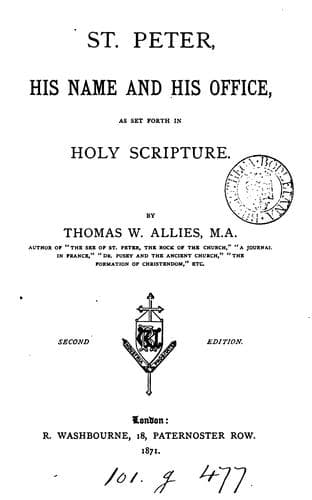
St. Peter, His Name and His Office, as Set Forth in Holy ScriptureAllies, T. W. (Thomas William)
Religion
St. Peter, His Name and His Office, as Set Forth in Holy Scripture
Allies, T. W. (Thomas William)
Peter, the Apostle, Saint
For imagine, that upon our Lord's departure, no one had been deputed
to take the visible headship and rule over the Church. How, without
ever fresh revelations, and an abiding miraculous power, could that
complex unity of faith, of worship, and of polity, have been
maintained, which the[25] Lord has set forth as the very sign and
token of His Church? A multitude scattered throughout the most
distant regions, and naturally differing in race, in habits, in
temperament, how could it possibly be joined in one, and remain one,
without a powerful bond of unity? Hence, in the fourth century, S.
Jerome[26] observed, "The safety of the Church depends on the
dignity of the supreme Priest, in whom, if all do not recognise a
peculiar and supereminent power, there will arise as many schisms in
the Church as there are priests." And the repentant confessors out
of Novatian's schism, in the middle of the third century, "We know
that Cornelius (the Pope) has been elected Bishop of the most holy
Catholic Church, by Almighty God, and Christ our Lord.--We are not
ignorant that there is one God, one Christ the Lord, whom we
confessed, one Holy Spirit, and that there ought to be one bishop
in the Catholic Church."[27] And these words, both of S. Jerome, and
of the confessors, if they primarily apply to the diocesan bishop
among his priests and people, so do they with far greater force
apply to the chief bishop among his brethren in the whole Church.
Now, as our Lord willed that His Church should do without fresh
revelations, and new miracles, such as at first accredited it, and
that it should preserve unity; and as, when it was a little flock,
which could be assembled in a single room, it had yet one visible
Ruler, how can we doubt that He willed this form of government to
remain, and that there should be one perpetually to rule it in His
name, and preserve it in unity, since it was to become co-extensive
with the earth?
Again, we may ask, was the condition of fold, house, family, city,
and kingdom, so repeatedly set forth in Holy Scripture, to belong to
the Church only while Christ was yet on earth, or to be the visible
evidence of its truth for ever? Do these terms exhibit a temporary,
or a perpetual state? Each one of these symbols by itself, and all
together, involve one visible Ruler: therefore, so long as the
Church can be called with truth, the one house, the one family, the
one city, the one fold, the one kingdom, so long must it have one
visible and supreme Ruler.
But once grant that such a one there was after our Lord's departure,
and no one can doubt that one to have been Peter. It is easier to
deny the supreme Ruler altogether, than to make him any one but
Peter. The whole course of the Gospels shows none other marked out
by so many distinctions. Thus, even those who wish to refuse a real
power to his Primacy, are compelled by the force of evidence to
allow him a Primacy of order and honour.
Public-domain text, read in full here on John Shaqi.
Reviews
Reviews
No reviews yet
Be the first to share your thoughts on this work.
Join the Discussion
Join the discussion
Sign in to leave a comment or review.
Sign InorCreate an account