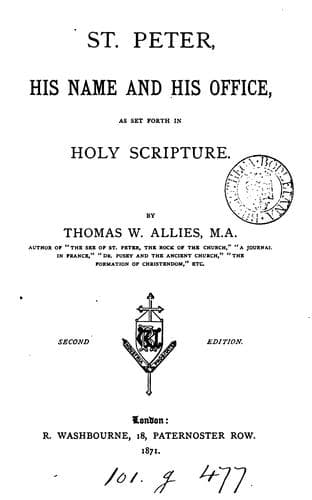
St. Peter, His Name and His Office, as Set Forth in Holy ScriptureAllies, T. W. (Thomas William)
Religion
St. Peter, His Name and His Office, as Set Forth in Holy Scripture
Allies, T. W. (Thomas William)
Peter, the Apostle, Saint
head of all the Apostles; and all would fairly expect those acts of
Peter, if they recognised him as so set over all by Christ. Now in
the general history of the Apostles we find such acts recorded of
Peter, and that not partially, here and there, but in a complete
series. Accordingly the history of the rising Church, exhibited in
the first part of the Acts, demands Peter's Primacy for its
explanation; and if we deny that Primacy, and take in another sense
the words recording its institution in the Gospel, the history
becomes unintelligible."
Now this reasoning is conclusive in either way, provided only that
what we have asserted be really found in the Acts. The proof of this
may be either general, or piecemeal and particular. We will take
both in order, beginning with the former.
1. First, [8]then, we must repeat, as concerns that whole portion of
the Acts containing the history of the universal Church, and all
the Apostles, viz. the first twelve chapters, a remark before made
as to the Gospels, which is, that Peter simply is more often
mentioned than all the rest put together. For Peter's name occurs
more than fifty times, the others very seldom, and those who are
found the oftenest, John and James, are recorded, the former seven
or eight, the latter three or four times. Yet this is a history of
them all: Luke is recording the common exertions of all the Apostles
in building up the Church. This is the very distinction between the
former and the latter portion of his book, which is confined to the
labours of S. Paul, leaving aside the rest of the Church. What then
is the reason that Peter, in a general history, is so often brought
forward, and the rest, either singly or in conjunction, so seldom?
Because after our Lord's glorious ascension Peter stood to the
eleven in an analogous position to that held by our Lord, so long as
He was visible, towards the whole college: because Peter was become
the head, and the rest, as members, were ranged under him.
2. Such subordination on their part, such pre-eminence on his,[9]
Luke shows yet more clearly, whenever he groups Peter with the rest,
by assigning to him the leading place. It frequently happens to him
to speak of Peter and the rest together, but on no one occasion does
he give Peter any but the first place, and the leading part. Just as
the evangelists do with regard to Christ, and the Apostles and
disciples, so Luke prefers Peter to the rest, to mark a difference
between the rank and office of Peter, and that of the others.
Public-domain text, read in full here on John Shaqi.
Reviews
Reviews
No reviews yet
Be the first to share your thoughts on this work.
Elsewhere in the archive
Join the Discussion
Join the discussion
Sign in to leave a comment or review.
Sign InorCreate an account