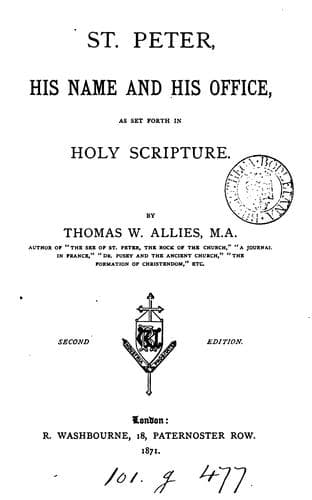
St. Peter, His Name and His Office, as Set Forth in Holy ScriptureAllies, T. W. (Thomas William)
Religion
St. Peter, His Name and His Office, as Set Forth in Holy Scripture
Allies, T. W. (Thomas William)
Peter, the Apostle, Saint
3. Luke seems to confirm his readers in such a conclusion by the
form which he follows of mentioning Peter _directly_, and the rest
_obliquely_ or _in a mass_. These are instances: "In those days
Peter, _rising up in the midst of the brethren_, said"--"Peter,
_standing up with the eleven_, lifted up his voice"--"They said _to
Peter and to the rest of the Apostles_"--"Peter _with John_
fastening his eyes upon him said, Look upon us."--"Peter _and the
Apostles_ answering, said."[10] Now what form of writing could Luke
choose to refute an opinion about the _universal_ equality of the
Apostles? Or to show Peter as set over the rest, and to satisfy in
this even the most unreasonable? Either the form which he did choose
is calculated to do this, or none such can be found.
4. Add to this that Peter is represented as speaking and answering,
when the occasion would suggest that all the Apostles, equally,
should disclose their mind. The reproaches of the unbelieving Jews
affected not Peter singly, but all alike; but he alone stands forth,
he alone lifts up his voice, and in a long speech brings them to
sound reflection. The multitude, struck with compunction, asked not
Peter only, but the rest likewise, "What shall we do, men and
brethren?" Yet it is forthwith added, "But _Peter_ said to them."
Upon the miracle by which one who had been lame from his mother's
womb was healed, "all the people ran together to them," both Peter
and John, but Peter alone speaks, and takes on himself the defence
of the common cause: "Peter seeing, made answer to the people."[11]
Fresh instances may be found in chs. iv. 6-7, and v. 2-3. The result
of the whole is that Peter is continually "the mouth-piece of the
Apostles,"[12] always takes the lead, and gives his own mind, as
conveying that of the rest.
On what ground does he do this? Was it from natural fervour of
disposition? But it was the same after he was filled with the Holy
Spirit as before. Was it the result of superior age, or first
calling? but the facts refute this. What other cause can be
suggested save that Primacy which the Gospels record, and the Acts
confirm?
Public-domain text, read in full here on John Shaqi.
Reviews
Reviews
No reviews yet
Be the first to share your thoughts on this work.
Elsewhere in the archive
Join the Discussion
Join the discussion
Sign in to leave a comment or review.
Sign InorCreate an account