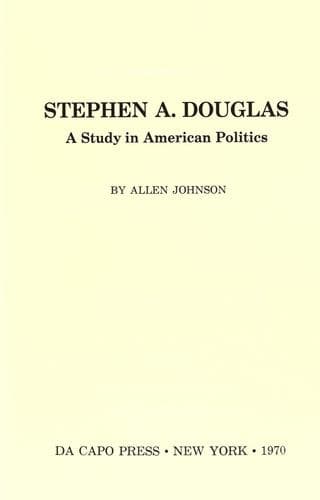
Stephen A. Douglas: A Study in American PoliticsJohnson, Allen
History
Stephen A. Douglas: A Study in American Politics
Johnson, Allen
Douglas, Stephen A. (Stephen Arnold), 1813-1861
At the close of this eventful year, the political situation in
Illinois was without precedent. To offset Democratic losses in the
presidential election, there were, to be sure, the usual Democratic
triumphs in State and district elections. But the composition of the
legislature was peculiar. On the vote for Speaker of the House, the
Democrats showed a handsome majority: there was no sign of a third
party vote. A few days later the following resolution was carried by a
vote which threw the Democratic ranks into confusion: "That our
senators in Congress be instructed, and our representatives requested,
to use all honorable means in their power, to procure the enactment of
such laws by Congress for the government of the countries and
territories of the United States, acquired by the treaty of peace,
friendship, limits, and settlement, with the republic of Mexico,
concluded February 2, A.D. 1848; as shall contain the express
declaration, that there shall be neither slavery, nor involuntary
servitude in said territories, otherwise than for the punishment of
crimes, whereof the party shall have been duly convicted."[318]
At least fifteen representatives of what had hitherto been Democratic
constituencies, had combined with the Whigs to embarrass the
Democratic delegation at Washington.[319] Their expectation seems to
have been that they could thus force Senator Douglas to resign his
seat, for he had been an uncompromising opponent of the Wilmot
Proviso. Free-Soilers, Whigs, and Northern Democrats with anti-slavery
leanings had voted for the instructions; only the Democrats from the
southern counties voted solidly to sustain the Illinois delegation in
its opposition to the Proviso.[320] While not a strict sectional vote,
it showed plainly enough the rift in the Democratic party. A
disruptive issue had been raised. For the moment a re-alignment of
parties on geographical lines seemed imminent. This was precisely the
trend in national politics at this moment.
There was a traditional remedy for this sectional malady--compromise.
It was an Illinois senator, himself a slave-owner, who had proposed
the original Missouri proviso. Senator Douglas had repeatedly proposed
to extend the Missouri Compromise line to the Pacific, in the same
spirit in which compromise had been offered in 1820, but the essential
conditions for a compromise on this basis were now wanting.
Public-domain text, read in full here on John Shaqi.
Reviews
Reviews
No reviews yet
Be the first to share your thoughts on this work.
Elsewhere in the archive
Join the Discussion
Join the discussion
Sign in to leave a comment or review.
Sign InorCreate an account