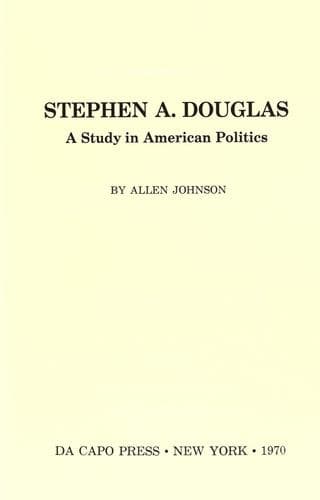
Stephen A. Douglas: A Study in American PoliticsJohnson, Allen
History
Stephen A. Douglas: A Study in American Politics
Johnson, Allen
Douglas, Stephen A. (Stephen Arnold), 1813-1861
It was precisely at this time, when the Illinois legislature was
instructing him to reverse his attitude toward the Wilmot Proviso,
that Senator Douglas began to change his policy. Believing that the
combination against him in the legislature was largely accidental and
momentary, he refused to resign.[321] Events amply justified his
course; but the crisis was not without its lessons for him. The
futility of a compromise based on an extension of the Missouri
Compromise line was now apparent. Opposition to the extension of
slavery was too strong; and belief in the free status of the acquired
territory too firmly rooted in the minds of his constituents. There
remained the possibility of reintegrating the Democratic party through
the application of the principle of "squatter sovereignty," Was it
possible to offset the anti-slavery sentiment of his Northern
constituents by an insistent appeal to their belief in local
self-government?
The taproot from which squatter sovereignty grew and flourished, was
the instinctive attachment of the Western American to local
government; or to put the matter conversely, his dislike of external
authority. So far back as the era of the Revolution, intense
individualism, bold initiative, strong dislike of authority, elemental
jealousy of the fruits of labor, and passionate attachment to the soil
that has been cleared for a home, are qualities found in varying
intensity among the colonists from New Hampshire to Georgia. Nowhere,
however, were they so marked as along the Western border, where
centrifugal forces were particularly strong and local attachments were
abnormally developed. Under stress of real or fancied wrongs, it was
natural for settlers in these frontier regions to meet for joint
protest, or if the occasion were grave enough, to enter into political
association, to resist encroachment upon what they felt to be their
natural rights. Whenever they felt called upon to justify their
course, they did so in language that repeated, consciously or
unconsciously, the theory of the social contract, with which the
political thought of the age was surcharged. In these frontier
communities was born the political habit that manifested itself on
successive frontiers of American advance across the continent, and
that finally in the course of the slavery controversy found apt
expression in the doctrine of squatter sovereignty.[322]
None of the Territories carved out of the original Northwest had shown
greater eagerness for separate government than Illinois. The isolation
of the original settlements grouped along the Mississippi, their
remoteness from the seat of territorial government on the Wabash, and
the consequent difficulty of obtaining legal protection and efficient
government, predisposed the people of Illinois to demand a territorial
government of their own, long before Congress listened to their
memorials. Bitter controversy and even bloodshed attended their
efforts.[323]
Public-domain text, read in full here on John Shaqi.
Reviews
Reviews
No reviews yet
Be the first to share your thoughts on this work.
Elsewhere in the archive
Join the Discussion
Join the discussion
Sign in to leave a comment or review.
Sign InorCreate an account