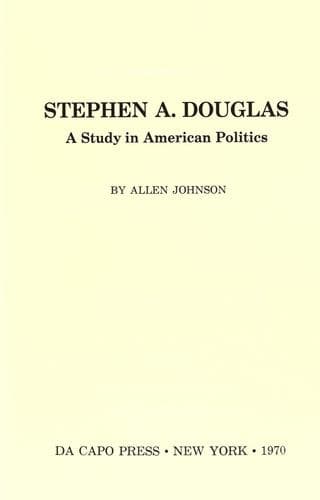
Stephen A. Douglas: A Study in American PoliticsJohnson, Allen
History
Stephen A. Douglas: A Study in American Politics
Johnson, Allen
Douglas, Stephen A. (Stephen Arnold), 1813-1861
The concessions made by the constitutional convention of 1847, in the
matter of local government, gave great satisfaction to the Northern
element in the State. The new constitution authorized the legislature
to pass a general law, in accordance with which counties might
organize by popular vote under a township system. This mode of
settling a bitter and protracted controversy was thoroughly in accord
with the democratic spirit of northern Illinois. The newspapers of the
northern counties welcomed the inauguration of the township system as
a formal recognition of a familiar principle. Said the _Will County
Telegraph_:[325] "The great principle on which the new system is based
is this: that except as to those things which pertain to State unity
and those which are in their nature common to the whole county, it is
right that each small community should regulate its own local matters
without interference." It was this sentiment to which popular
sovereignty made a cogent appeal.
No man was more sensitive than Senator Douglas to these subtle
influences of popular tradition, custom, and current sentiment. Under
the cumulative impression of the events which have been recorded, his
confidence in popular sovereignty as an integrating force in national
and local politics increased, and his public utterances became more
assured and positive.[326] By the close of the year 1850, he had the
satisfaction of seeing the collapse of the Free-Soil party in
Illinois, and of knowing that the joint resolutions had been repealed
which had so nearly accomplished his overthrow. A political storm had
been weathered. Yet the diverse currents in Illinois society might
again roil local politics. So long as a bitter commercial rivalry
divided northern and southern Illinois, and social differences held
the sections apart, misunderstandings dangerous to party and State
alike would inevitably follow. How could these diverse elements be
fused into a true and enduring union? To this task Douglas set his
hand. The ways and means which he employed, form one of the most
striking episodes in his career.
* * * * *
FOOTNOTES:
[Footnote 294: Reid was afterward Governor of North Carolina and
United States Senator.]
[Footnote 295: For many of the facts relating to Douglas's courtship
and marriage, I am indebted to his son, Judge Robert Martin Douglas,
of North Carolina.]
[Footnote 296: At the death of Colonel Martin, this plantation was
worked by some seventeen slaves, according to his will.]
[Footnote 297: This impression is fully confirmed by the terms of his
will.]
[Footnote 298: He was himself fully conscious of this influence. See
his speech at Raleigh, August 30, 1860.]
[Footnote 299: The facts are so stated in Colonel Martin's will, for a
transcript of which I am indebted to Judge R.M. Douglas.]
[Footnote 300: Extract from the will of Colonel Martin.]
Public-domain text, read in full here on John Shaqi.
Reviews
Reviews
No reviews yet
Be the first to share your thoughts on this work.
Elsewhere in the archive
Join the Discussion
Join the discussion
Sign in to leave a comment or review.
Sign InorCreate an account