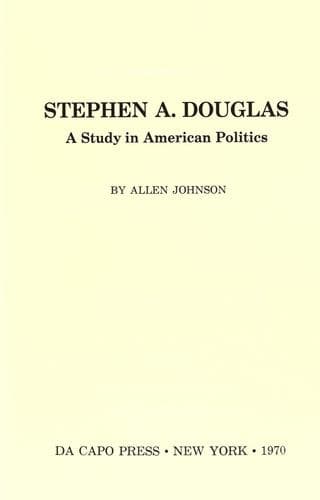
Stephen A. Douglas: A Study in American PoliticsJohnson, Allen
History
Stephen A. Douglas: A Study in American Politics
Johnson, Allen
Douglas, Stephen A. (Stephen Arnold), 1813-1861
There was not the slightest prospect, however, that moderate views
would prevail. Log-rolling had already begun; the lobby was active;
and every member of the legislature who had pledged himself to his
constituents was solicitous that his section of the State should not
be passed over, in the general scramble for appropriations. In the end
a bill was drawn, which proposed to appropriate no less than
$10,230,000 for public works. A sum of $500,000 was set aside for
river improvements, but the remainder was to be expended in the
construction of eight railroads. A sop of $200,000 was tossed to those
counties through which no canal or railroad was to pass.[61] What were
prudent men to do? Should they support this bill, which they believed
to be thoroughly pernicious, or incur the displeasure of their
constituents by defeating this, and probably every other, project for
the session? Douglas was put in a peculiarly trying position. He had
opposed this "mammoth bill," but he knew his constituents favored it.
With great reluctance, he voted for the bill.[62] He was not minded
to immolate himself on the altar of public economy at the very
threshold of his career.[63]
Much the same issue was forced upon Douglas in connection with the
Illinois and Michigan canal. Unexpected obstacles to the construction
of the canal had been encountered. To allow the waters of Lake
Michigan to flow through the projected canal, it was found that a cut
eighteen feet deep would have to be made for twenty-eight miles
through solid rock. The cost of such an undertaking would exceed the
entire appropriation. It was then suggested that a shallow cut might
be made above the level of Lake Michigan which would then permit the
Calumet River or the Des Plaines, to be used as a feeder. The problem
was one for expert engineers to solve; but it devolved upon an
ignorant assembly, which seems to have done its best to reduce the
problem to a political equation. A majority of the House--Douglas
among them--favored a shallow cut, while the Senate voted for the deep
cut. The deadlock continued for some weeks, until a conference
committee succeeded in agreeing upon the Senate's programme. As a
member of the conferring committee, Douglas vigorously opposed this
settlement, but on the final vote in the House he yielded his
convictions. In after years he took great satisfaction in pointing
out--as evidence of his prescience--that the State became financially
embarrassed and had finally to adopt the shallow cut.[64]
The members of the 10th General Assembly have not been wont to point
with pride to their record. With a few notable exceptions they had
fallen victims to a credulity which had become epidemic. When the
assembly of 1840 repealed this magnificent act for the improvement of
Illinois, they encountered an accumulated indebtedness of over
$14,000,000. There are other aspects of the assembly of 1836-37 upon
which it is pleasanter to dwell.
Public-domain text, read in full here on John Shaqi.
Reviews
Reviews
No reviews yet
Be the first to share your thoughts on this work.
Join the Discussion
Join the discussion
Sign in to leave a comment or review.
Sign InorCreate an account