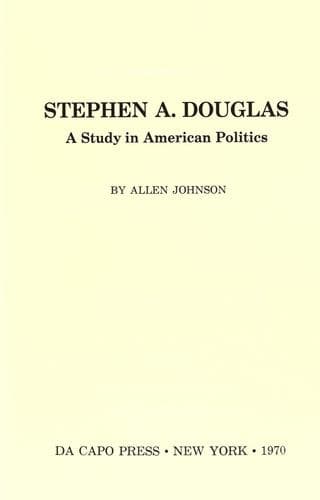
Stephen A. Douglas: A Study in American PoliticsJohnson, Allen
History
Stephen A. Douglas: A Study in American Politics
Johnson, Allen
Douglas, Stephen A. (Stephen Arnold), 1813-1861
As chairman of a committee on petitions Douglas rendered a real
service to public morality. The general assembly had been wont upon
petition to grant divorces by special acts. Before the legislature had
been in session ten days, no less than four petitions for divorces had
been received. It was a custom reflecting little credit upon the
State.[65] Reporting for his committee, Douglas contended that the
legislature had no power to grant divorces, but only to enact salutary
laws, which should state the circumstances under which divorces might
be granted by the courts. The existing practice, he argued, was
contrary to those provisions of the constitution which expressly
separated the three departments of government. Moreover, everyone
recognized the injustice and unwisdom of dissolving marriage contracts
by act of legislature, upon _ex parte_ evidence.[66] Without
expressing an opinion on the constitutional questions involved, the
assembly accepted the main recommendation of the committee, that
henceforth the legislature should not grant bills of divorce.[67]
One of the recurring questions during this session was whether the
State capital should be moved. Vandalia was an insignificant town,
difficult of access and rapidly falling far south of the center of
population in the State. Springfield was particularly desirous to
become the capital, though there were other towns which had claims
equally strong. The Sangamon County delegation was annoyingly
aggressive in behalf of their county seat. They were a conspicuous
group, not merely because of their stature, which earned for them the
nickname of "the Long Nine," but also because they were men of real
ability and practical shrewdness. By adroit management, a vote was
first secured to move the capital from Vandalia, and then to locate it
at Springfield. Unquestionably there was some trading of votes in
return for special concessions in the Internal Improvements bill. It
is said that Abraham Lincoln was the virtual head of the Sangamon
delegation, and the chief promoter of the project.[68]
Public-domain text, read in full here on John Shaqi.
Reviews
Reviews
No reviews yet
Be the first to share your thoughts on this work.
Join the Discussion
Join the discussion
Sign in to leave a comment or review.
Sign InorCreate an account