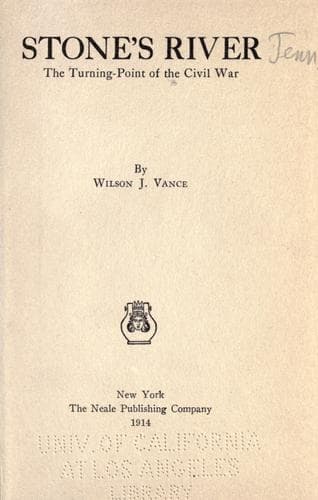
Stone's River: The Turning-Point of the Civil WarVance, Wilson J.
History
Stone's River: The Turning-Point of the Civil War
Vance, Wilson J.
Stones River, Battle of, Murfreesboro, Tenn., 1862-1863
It is, perhaps, too much to say that the British Ministry had always
inclined to a recognition of the Confederacy. But as the war progressed
and its desperate and extensive character began to be revealed, the
project of some action tending to this end was frequently discussed in
Downing Street. The British premier at this time was Lord Palmerston, and
next in rank to him in the Cabinet was Lord John Russell, Secretary of
State for Foreign Affairs. Practised and polished politicians both, they
had been able to adjust their ambitions and predilections in this instance
to mutual satisfaction. But a third member of the Ministry, the Chancellor
of the Exchequer gave them both great concern. William Ewart
Gladstone,--whose genius was then being revealed in full proportion to
the English public,--was too able, too popular, and, above all, too
formidable to be left out of the Coalition Cabinet. But it is well
established that he was regarded with personal dislike and with
professional jealousy by his veteran colleagues. This feeling of animosity
was to lead to a most singular consequence,--one that had a grave bearing
on American affairs.
The stopping by a United States warship of the Royal Mail Steamer _Trent_
in November, 1861, and the removal therefrom of the Confederate envoys,
Mason and Slidell, brought the two countries to the brink of war. Only the
prompt, complete, and skillful disavowal of the American Government served
to avert hostilities, preparations for which had already begun on the part
of Great Britain. The temper and disposition of Her Majesty's Ministry
were plainly shown in the truculent tone of the demand framed by
Russell,--a paper that was adopted by the Cabinet, though Gladstone
suggested some modifications. However, it would have been sent as written,
had not the Queen, acting on the advice of the Prince Consort, insisted
upon a modification of some of the more offensive phrases. Had it not been
for this kindly and sagacious interposition of Queen Victoria, the
situation might have gone beyond the power of the Lincoln Government to
control.
The smothering of the _Trent_ incident in the honey of diplomacy left the
Ministry without an immediate and direct pretext for unfriendly action,
but there remained a feeling of irritation and a tacit determination to do
something when a proper opportunity should occur.
The Confederate successes in the summer of 1862 were convincing proofs to
the British mind that the independence of the South was only a matter of
time, and discussions of the subject were frequent at the Cabinet
meetings. Those were anxious times for the American Minister, Charles
Francis Adams, whose personal luggage was kept packed in anticipation of a
sudden breach of diplomatic relations which would necessitate his
departure from the Court of St. James.
Public-domain text, read in full here on John Shaqi.
Reviews
Reviews
No reviews yet
Be the first to share your thoughts on this work.
Join the Discussion
Join the discussion
Sign in to leave a comment or review.
Sign InorCreate an account