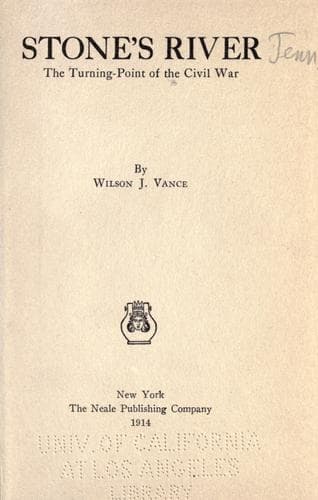
Stone's River: The Turning-Point of the Civil War — John Shaqi
Stone's River: The Turning-Point of the Civil WarVance, Wilson J.
History
Stone's River: The Turning-Point of the Civil War
Vance, Wilson J.
Stones River, Battle of, Murfreesboro, Tenn., 1862-1863
In plain defiance of international law, splendid vessels were built in
British yards for the purpose of sweeping the commerce of the United
States from the seas; Confederate rifles and cannon were readily procured
from British dealers; Confederate loans were floated by British bankers,
and over-subscribed by the British public; the sale of shares in British
blockade-runners to Confederate ports was an easy matter, as it appealed
not only to the cupidity but to the prejudice of the purchaser. All grades
of publications,--from the newspapers to the stately reviews,--teemed with
abuse of Americans,--abuse written in almost inconceivable ferocity and
malice. The humorous organ, _Punch_, did not check its "scurrile jester"
in the drawing of most offensive cartoons of the President of the United
States; practically the whole of the aristocracy was hostile; in all
Parliament but one voice was raised for the North, and that was the voice
of John Bright.
While the rancor and venom were expended upon the North, and while that
section suffered solely from the violations of international law, it must
not be supposed that the British press, patricians, and politicians were
actuated by any genuine motives of good will to the South. Their hope and
prayer were for the disruption and destruction of the Republic, in which
the nobility recognized their most powerful,--however passive,--enemy; and
the trading classes thought they saw the ruin of their commercial rival.
There was, however, one great element in England that was stanchly on the
side of the North throughout the whole conflict; and though it did not
possess the franchise, this element was not without its influence. The
working classes of the kingdom were able to penetrate the mists that
blinded their superiors in station, and they saw from the beginning that,
whatever the ostensible purpose, the actual result of Northern triumph
would be the end of slavery. It is at once a pathetic and magnificent
fact, that no amount of specious argument, such as was frequently
addressed to him, that no reflection upon his own sufferings, could win
the Lancashire cottonspinner,--starving, because of the shortage in the
great staple of his industry,--from the cause of human freedom.
Public-domain text, read in full here on John Shaqi.
Reviews
Reviews
No reviews yet
Be the first to share your thoughts on this work.
Join the Discussion
Join the discussion
Sign in to leave a comment or review.
Sign InorCreate an account