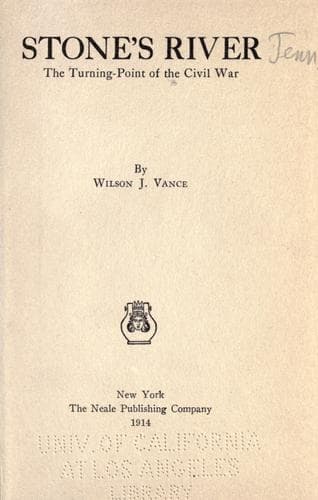
Stone's River: The Turning-Point of the Civil WarVance, Wilson J.
History
Stone's River: The Turning-Point of the Civil War
Vance, Wilson J.
Stones River, Battle of, Murfreesboro, Tenn., 1862-1863
After the battle of Shiloh, the Confederate forces of the Middle
West,--under Beauregard,--had retired to Corinth, Miss., which Halleck,
at the head of more than 100,000 men,--having gathered together Grant's
army, Buell's and all the other forces under his command,--approached with
ridiculous caution. After a somewhat farcical siege, in which Beauregard
played successfully for time, Corinth was suddenly and expeditiously
evacuated, and the Confederate Army reappeared in a strong position at
Tupelo, when, Beauregard having fallen ill, Bragg assumed command.
Halleck now divided his forces again, Buell,--at the head of what was now
known as the Army of the Cumberland,--being sent into Middle Tennessee to
begin a campaign long urged by President Lincoln for the relief of the
Unionists in the eastern part of that State, and Grant being left in
Mississippi, with somewhat widely-separated detachments, which ultimately
he was to concentrate in the campaign for Vicksburg. The taking of Memphis
(June 6) had already given the Union forces a foothold on the great river
and domination over Western Tennessee. Halleck was summoned to Washington
in July, to take command of all the armies in the field.
The dispersion of the Union forces in his front did not pass unnoticed by
Bragg, who soon conceived and put into execution one of the boldest plans
of campaign of the war. Early in June he began the shifting of his Army of
the Tennessee to Chattanooga, where, in conjunction with Kirby
Smith,--commanding a Confederate Army in East Tennessee,--he perfected
his scheme of operation. The prelude of his campaign was exhibited in the
form of extensive raids by Forrest's Cavalry and Morgan's, in which the
Federal lines of communication were repeatedly cut, huge stores of
supplies taken or destroyed, and several important posts captured. Early
in August the heavy columns of Confederate infantry and artillery began
pouring through the mountain passes into the coveted territory of
Kentucky.
Bragg's invasion of Kentucky was thus practically simultaneous with Lee's
invasion of Maryland; and the two movements caused the direst foreboding
and dismay in the North. The war was coming very close to the people of
that section when Confederate detachments appeared in the rear of
Covington, in sight of Cincinnati, and when the chief Confederate Army
crossed the Potomac into the Maryland that the Southern poets had already
immortalized in song. Not the least of the objects of these two campaigns
was the winning to the Confederate cause of the States invaded.
Public-domain text, read in full here on John Shaqi.
Reviews
Reviews
No reviews yet
Be the first to share your thoughts on this work.
Join the Discussion
Join the discussion
Sign in to leave a comment or review.
Sign InorCreate an account