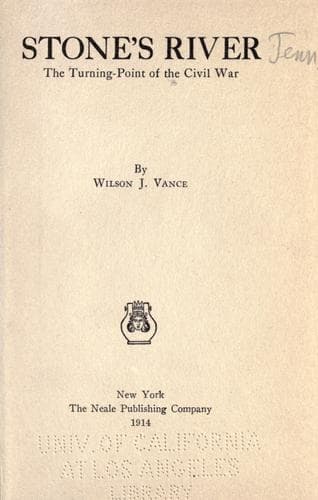
Stone's River: The Turning-Point of the Civil War — John Shaqi
Stone's River: The Turning-Point of the Civil WarVance, Wilson J.
History
Stone's River: The Turning-Point of the Civil War
Vance, Wilson J.
Stones River, Battle of, Murfreesboro, Tenn., 1862-1863
Nelson, with a small Union force, was badly beaten by Kirby Smith at
Richmond, Ky., August 23, and Louisville experienced the agonies of a
panic, for it was practically defenseless. Buell had been so mystified by
Bragg's movements that he did not start in pursuit until September 7, and
even then might not have reached Louisville in time, had not the
Confederate forces lost precious hours in taking Munfordville. But having
reached that city, Buell held the key to the situation, and Bragg was
forced to retire,--which he did slowly and carefully. At Perryville a
portion of Buell's army and some of Bragg's troops met on October 8 in a
fierce battle,--an engagement that will always be a source of mystery to
students, in that neither side took advantage of obvious opportunities.
Bragg, in this campaign, failed of a major object, which was to rouse
Kentucky for the Confederacy, though he went through the form of
inaugurating a Provisional Governor at the State capital, Frankfort; but
he did return South with long trains of fine horses and beeves, with
wagons richly laden with food and clothing, and with almost enough
recruits to offset the human wastage of his army on march and in battle.
Moreover, at the close of the campaign he was in the possession of some
territory heretofore held by Federal forces,--territory that was not
yielded up until almost a year later.
The disorganization in and near Washington,--consequent upon Pope's
defeat,--gave Lee an advantage which he improved by celerity of movement;
and he was well into Maryland before a Union army was got together to
oppose him. The command of this army was entrusted to McClellan, who
exercised his customary super-caution, one result of which was that
Harper's Ferry, with thousands of prisoners and great stores of military
supplies, fell,--with scarce a struggle,--into Lee's hands. This very
success might have been fatal to Lee,--for he had scattered his army to
accomplish this and other objects,--but McClellan, though fully aware of
the situation, moved too slowly, and the Southern general had time to
concentrate on the banks of Antietam Creek. Here, on September 17, was
fought one of the bloodiest battles of the war,--a battle in which the
Confederate Army stood off a foe twice as strong in numbers, and at length
retired at leisure, without further molestation. Like Bragg, Lee had
failed to win the State that he had invaded, but though he had suffered
tremendous losses, he had accomplished some important results.
Public-domain text, read in full here on John Shaqi.
Reviews
Reviews
No reviews yet
Be the first to share your thoughts on this work.
Join the Discussion
Join the discussion
Sign in to leave a comment or review.
Sign InorCreate an account