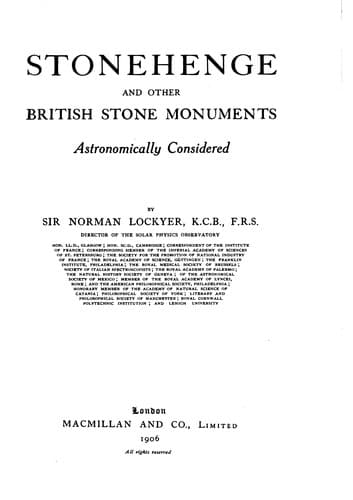
Stonehenge and Other British Stone Monuments Astronomically ConsideredLockyer, Norman, Sir
History
Stonehenge and Other British Stone Monuments Astronomically Considered
Lockyer, Norman, Sir
Druids and Druidism; Great Britain -- Antiquities; Stonehenge (England); Sun worship; Temples
Borlase points out with regard to the Irish dolmens that large tumuli
were not essential; all that was necessary was that the walls of the
cell or crypt should be impervious to the elements and to wild animals.
A creep or passage communicating with the edge of the mound is common to
Ireland, Wales, Portugal and Brittany (_op. cit._, p. 428).
The facts that the cairns so often had their open ends facing the N.E.
or S.E., and that the west end was generally higher, like the naos
trilithons at Stonehenge, must be borne in mind.
Most of what we know of earliest man has been obtained from their lives
in caves; what they ate, the contemporary fauna and their art are thus
known to us, but caves have not been considered as tombs, though men
have died and left their remains in them.
In the case of a dolmen, however, an artificial cave, as we shall see,
the possibility of people living in them appears never to have been
considered seriously, and the tomb theory has led to bad reasoning and
forced argument.
When burials are absent it has been suggested that “owing to some
peculiarity of the soil, the entire of the human remains have become
decomposed, only the imperishable stone implements entombed with the
body remaining.”[102]
Mr. Spence has pointed out the extreme improbability of Maeshowe being
anything but a temple, and I may now add on the Semitic model. There
were a large central hall and side rooms for sleeping, a stone door
which could have been opened or shut _from the inside_, and a niche for
a guard, janitor or hall porter! So high an authority as Colonel Leslie
has pointed out that neither Maeshowe, New Grange and Dowth on the
Boyne, nor Gavr Innis in Brittany bear any internal proof of being
specially prepared as tombs.[103]
There is another point connected with these dolmens and cromlechs. An
origin in the Semitic area easily explains why in Asia and Britain the
dolmens are so alike, down to small details, such as the perforation of
one of the side stones. Borlase has remarked also upon the similarity of
Indian and Irish dolmens (_op. cit._, p. 755), similar holes also being
common to them. The curious concentric circles, &c., found on some
dolmen stones are common to Assyrian vessels.[104]
The most philosophical study of this question I have seen[105] certainly
suggests that much light may be expected from this source.
Part of the cult of the sacred stones was the ceremony of _anointing
them_. Robertson Smith (p. 214) gives us the meaning and history of
anointing among the Semites, and notes its continuation from Jacob’s
pouring oil on sacred stones at Bethel, through the time of Pausanias to
that of the Pilgrims of the fourth century A.D.
The anointing of stones was certainly carried on in ancient times in
Britain and Brittany. Baring-Gould tells us:[106]
Public-domain text, read in full here on John Shaqi.
Reviews
Reviews
No reviews yet
Be the first to share your thoughts on this work.
Elsewhere in the archive
Join the Discussion
Join the discussion
Sign in to leave a comment or review.
Sign InorCreate an account